
The Jones Act Was Built for National Security. Is It Still Delivering?
While the Jones Act has value, it’s costs should not be accepted without scrutiny. The United States has attached legitimate national-security goals to a mechanism whose performance is increasingly difficult to reconcile with it’s original goals. This article seeks to clarify the current objectives and results of the Jones Act and seeks to answer “what next?”
For this article, the “Jones Act” refers to Section 27 of the Merchant Marine Act of 1920, the cargo-cabotage provision requiring merchandise transported between points in the United States to travel on vessels that are U.S.-built, U.S.-owned, U.S.-flagged or coastwise-endorsed, and primarily crewed by Americans. The federal government may waive those requirements under select circumstances when qualified vessels are unavailable.
The Jones Act began with an intuitively compelling proposition: a maritime nation should be able to move goods between its own ports using its own ships, shipyards, and mariners.
More than a century after Congress enacted that principle, however, the United States has fewer eligible oceangoing vessels, substantial gaps in an aged commercial fleet, and recurring situations in which the government temporarily permits foreign ships to carry American cargo between American ports.
The law’s objectives remain strategically serious.
It’s results are much harder to defend.
That makes the Jones Act more than an ordinary trade restriction. It is a national-security policy implemented through the commercial shipping market. The central question is whether the commercial restrictions are still producing the security capacity they were designed to preserve.
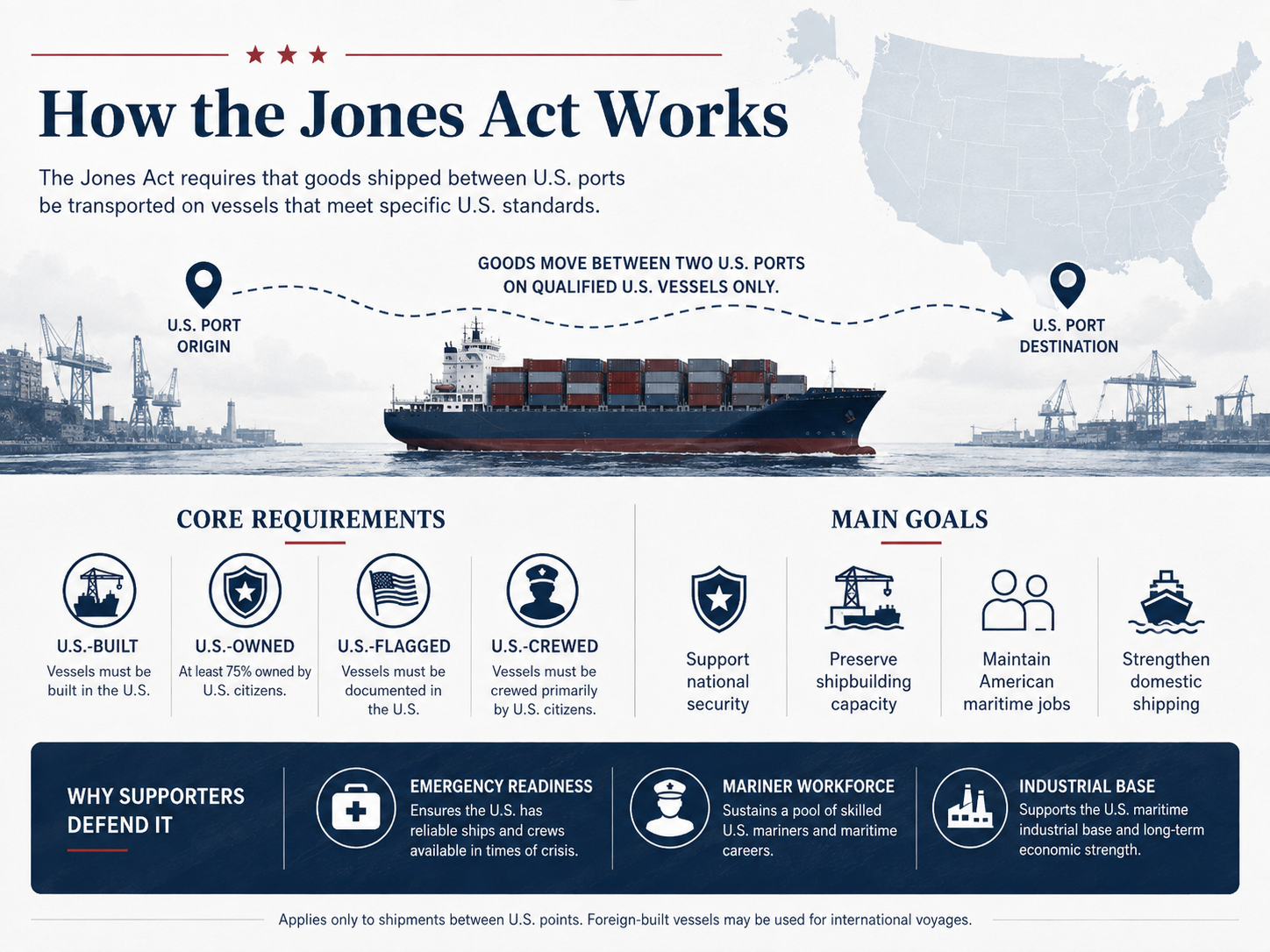
What the Jones Act is trying to protect
The strongest argument for the Jones Act is not that protected shipping will always be the cheapest form of transportation. It is that maritime capacity cannot be supported by foreign vessels where the risk of war or crisis arise.
The law seeks to preserve three connected resources: a U.S.-controlled commercial fleet that can supplement military sealift, a pool of American mariners qualified to crew reserve vessels, and domestic shipbuilding and repair facilities capable of supporting both commercial and national-security needs. The Congressional Research Service describes the law as accepting, to some extent, the higher price of American shipbuilding as a cost incurred for national security.
There is a coherent strategic case behind that arrangement. Ships have long operating lives. Shipyards require specialized infrastructure and skilled workers. Mariners cannot be trained overnight. A country that allows those capabilities to disappear may discover during a war, supply emergency, or international disruption that purchasing transportation abroad is no longer simple—or even possible.
The law also guarantees that at least part of domestic waterborne commerce remains under American ownership and regulation. That provides a measure of operational control and supports American maritime employment even when foreign operators can offer lower prices.
These are genuine strengths. Critics of the law sometimes move too quickly from “American ships are more expensive” to “American maritime capacity has no strategic value.” The second conclusion does not automatically follow from the first.
The uncomfortable measure: the fleet itself
The difficulty for Jones Act supporters is that a policy designed to maintain maritime capacity should ultimately be judged by the capacity it maintains.
On that measure, the record is troubling.
According to the Congressional Research Service (CRS), the Jones Act-eligible fleet declined from 181 ships in 2000 to 93 today. The remaining fleet lacks several common vessel types, including oceangoing dry-bulk ships, chemical tankers, liquefied petroleum gas tankers, liquefied natural gas tankers, and a range of heavy-transport vessels.
That is not a minor technical problem. Different ships are not interchangeable.
An oil tanker cannot simply perform the work of an LNG carrier. A coastal barge may transport certain products, but it generally offers less capacity and lower speed than a self-propelled oceangoing ship. A fleet can therefore exist on paper while remaining unable to serve the required domestic trade routes.
The CRS brief offers several pertinent examples of the resulting trade market distortions. Puerto Rico imports rice from China rather than relying on domestic US suppliers. American steel scrap may be exported across the Atlantic while foreign scrap is imported for U.S. mills. A Louisiana fertilizer producer has found it more economical to obtain phosphate rock from Peru than to ship material from Florida. American producers export chemicals such as ammonia, propane, ethane, and methanol abroad while some U.S. regions import those same products.
Not every unusual trade route can be blamed on one statute. Commodity prices, port infrastructure, contracts, geography, and vessel availability all matter. But the examples expose the underlying problem: a law intended to encourage domestic maritime commerce can make some domestic maritime commerce commercially impractical.
Protection is not the same as capacity. A market can be protected and still shrink.
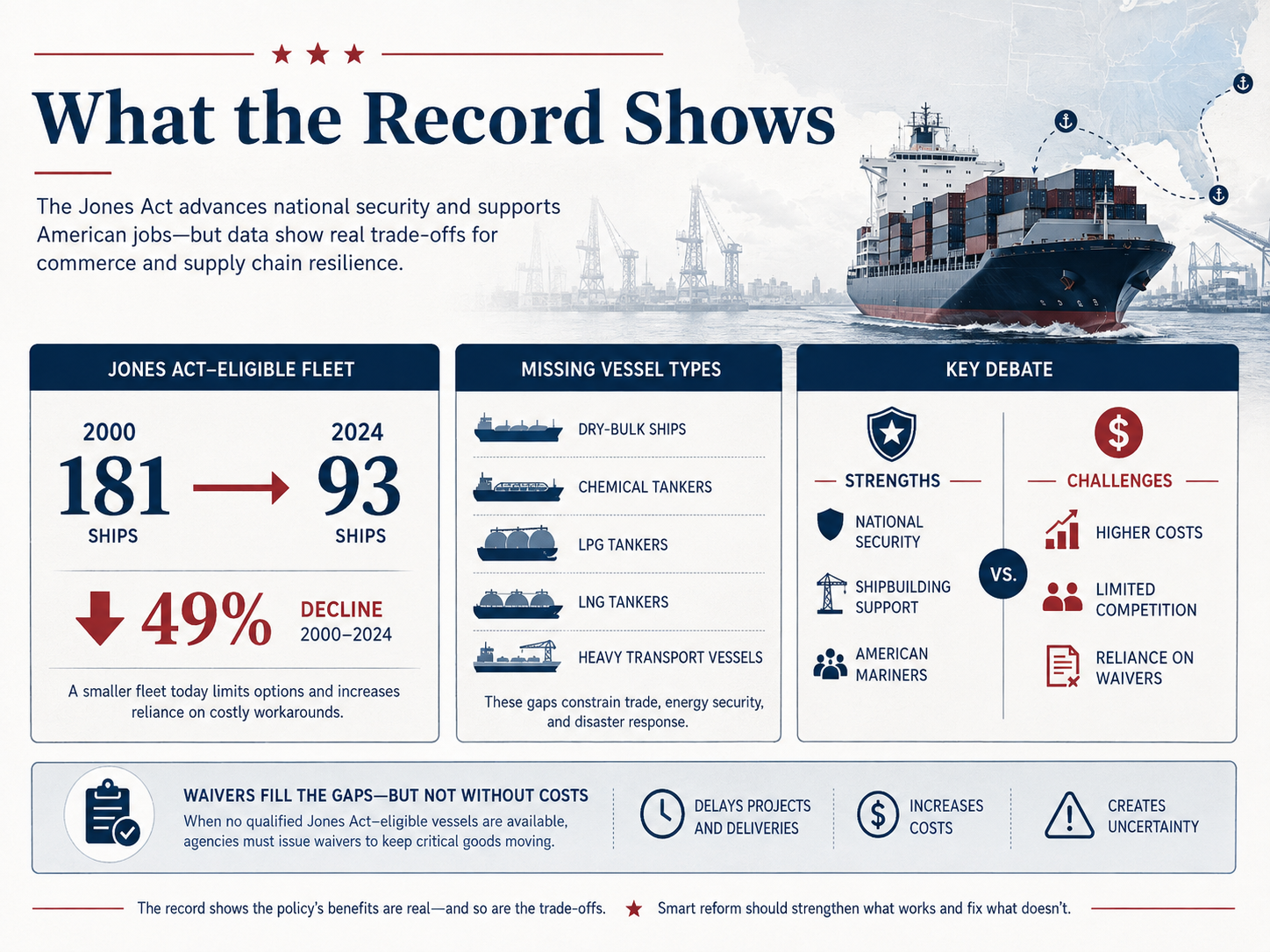
Where the critics have a strong case
The Pacific Legal Foundation and the Cato Institute have cast a spotlight on the issues, contending that the Jones Act raises transportation costs, suppresses competition, discourages modernization, and harms places that depend heavily on ocean shipping—especially Alaska, Hawaii, and Puerto Rico. Both organizations advocate repeal or major reform and should be understood as participants in the policy debate rather than neutral observers.
Their central economic criticism is difficult to dismiss.
Requiring vessels to be constructed in the United States limits the pool of ships available for domestic service. If American-built ships cost more than comparable foreign-built vessels, operators must either absorb that cost, pass it to customers, postpone replacement, or avoid entering the market. The shrinking fleet suggests that protection alone has not generated sufficient investment to overcome that calculation.
The burden is especially visible in the aforementioned noncontiguous states and territories, where maritime shipping is not one option among many. A business in Colorado can often choose among road, rail, or air freight. An island economy cannot build a highway to the mainland.
In 2026, the reform campaign broadened beyond free-market policy organizations. The National Energy & Fuels Institute reported that 14 national trade associations representing energy, agriculture, restaurants, and food-supply interests urged Congress to modernize the law. Americans for Prosperity separately led a coalition calling for permanent repeal, arguing that the restrictions reduce competition and increase the cost of moving essential goods.
Those coalitions have institutional interests of their own. Energy suppliers naturally prefer access to more vessels, just as domestic shipyards and maritime labor organizations naturally prefer continued protection. But the range of industries seeking change suggests that dissatisfaction with the Jones Act is no longer confined to a narrow ideological campaign.
The waiver problem: safety valve or diagnosis?
The Jones Act contains a waiver mechanism, and that flexibility is one of the law’s strengths.
Under federal law, the government can temporarily permit otherwise ineligible vessels to move cargo between U.S. ports when national-interest requirements are met and coastwise-qualified vessels are unavailable. MARAD publishes reports identifying waiver voyages, vessels, ports, cargoes, and the stated national interest.
The current safety valve is sensible. Further to this, no domestic-content policy should prevent fuel, food, or emergency supplies from reaching Americans during a serious disruption merely to preserve the purity of the rule.
But frequent or economically significant waivers also raise an uncomfortable question: are they exceptional relief from an unforeseeable crisis, or evidence that the protected fleet cannot perform the work the country needs?
The American Petroleum Institute reports that 109 waivers had been used during the 2026 energy disruption covered by its analysis. It says that, during the first 76 days, more gasoline and jet fuel moved by water from the Gulf Coast to the West Coast than had moved along that route during the previous 11 years combined. Approximately eight million barrels of fuel and refinery feedstocks reached California by water, according to the industry group.
API is an energy-industry advocate, and its interpretation favors broader shipping flexibility. Nevertheless, the movement of that cargo demonstrates something important: domestic supply and domestic demand exist, but the normal Jones Act fleet is not sufficient to connect them at the necessary scale.
The waiver worked. That is a point in favor of the law’s emergency architecture.
The fact that it was needed is a point against the adequacy of the system operating underneath it.
Repeal is not the only question
The case against the current Jones Act is stronger than the case against every policy intended to preserve American maritime capacity.
That distinction matters.
Simply repealing the law could lower barriers to domestic shipping and give businesses access to a much larger international fleet. It could also weaken demand for American-built vessels unless Congress replaced the Jones Act with more direct support for shipyards, mariners, and military sealift capability.
Keeping the law unchanged carries the opposite risk: the United States may continue paying a national-security premium without receiving a fleet large or diverse enough to meet national needs.
The Congressional Research Service points toward a more demanding policy conversation. Congress could ask whether existing incentives are sufficient, whether new support should target vessel categories missing from the fleet, and whether rebuilding domestic commercial shipbuilding will require direct federal investment over an extended period.
That approach would judge maritime policy by results rather than labels.
How many ships are being built? Which kinds? Are shipyards expanding their workforce and productivity? Is the pool of qualified mariners growing? Are domestic water routes becoming commercially usable? Can the fleet respond during a military or supply emergency without repeated waivers?
A law should not be credited with preserving an industry merely because preservation is stated in its purpose.
Why this matters for our Chapter
At first glance, the Jones Act may appear remote from the concerns of a United Nations Association chapter in landlocked Colorado.
It is not.
The debate sits at the intersection of supply-chain resilience, labor standards, industrial policy, national security, energy access, and the rules governing international commerce. It also reflects a question that appears throughout multilateral policy: when is national self-sufficiency a legitimate form of resilience, and when does it become an expensive barrier that leaves a country less prepared?
The Jones Act’s supporters are right about one fundamental point. A nation that depends entirely on foreign ships, foreign crews, and foreign shipyards accepts a strategic vulnerability.
Its critics are right about another. A protected industry that steadily loses ships, routes, and capabilities cannot rely on its strategic purpose as proof of strategic success.
The questions Congress should be asking are not merely whether to preserve or repeal a century-old statute.
They are these:
What maritime capabilities does the United States actually require for commerce, emergencies, and military sealift?
Which parts of that capacity must remain American-owned, American-crewed, or American-built?
Should national-security capacity be financed transparently through public investment rather than indirectly through higher shipping costs?
And how long should a shrinking fleet be treated as evidence that the policy protecting it is working?
The Jones Act was created because the United States feared entering the next crisis without enough ships. A century later, that remains a reasonable fear. Whether the law is solving it is another matter.
