Colorado’s
United Nations Association
in Boulder
Stay informed with the latest news and events.

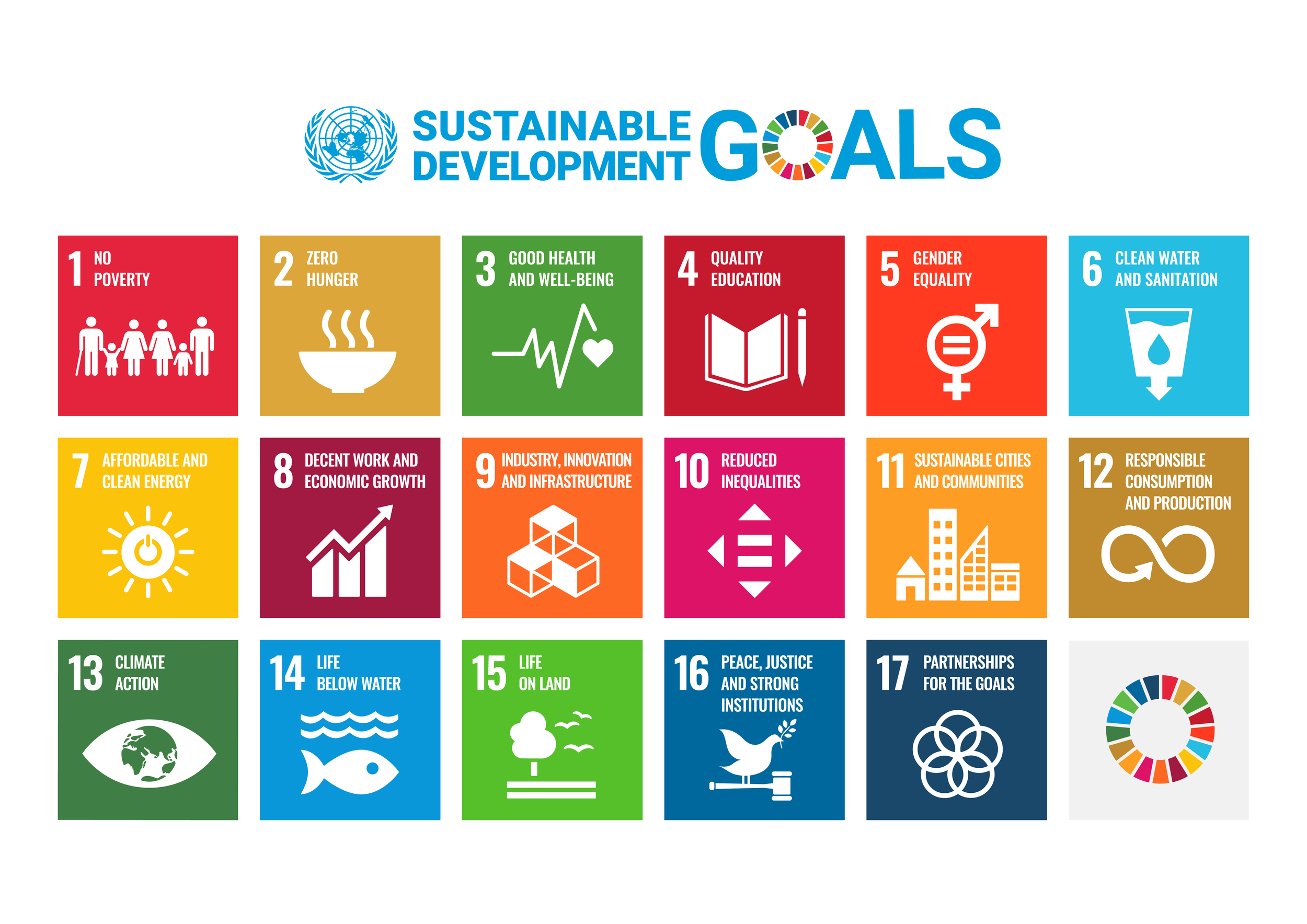
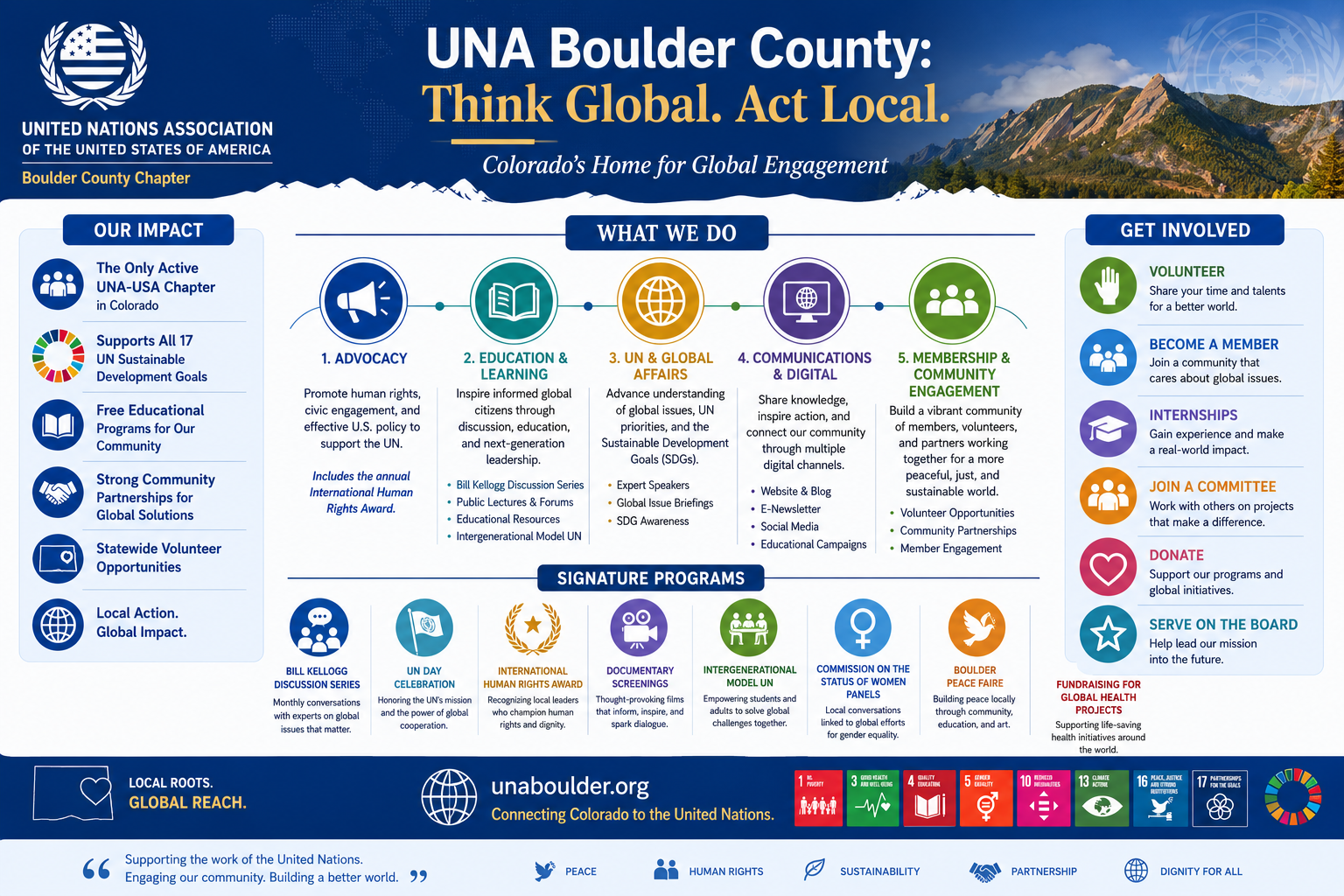
Founded in 1964 to support the mission of the United Nations and the 17 Sustainable Development Goals, we are Colorado’s UNA in Boulder.
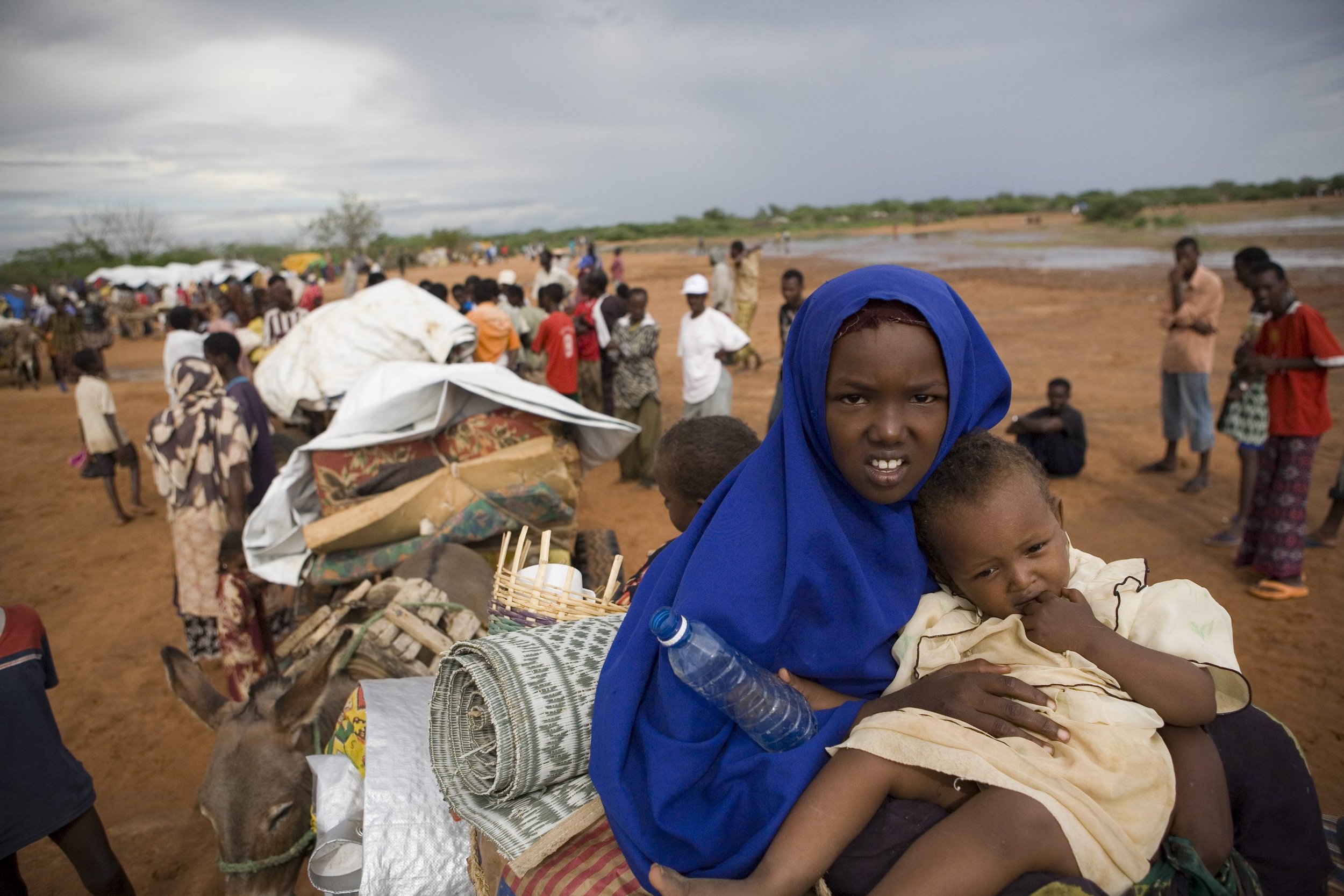
It's easy to think of UN dues as money that leaves the country. The reality is closer to the opposite: U.S. investment in the United Nations is one of the most cost-effective tools in the American foreign policy toolkit, because it leverages resources from 192 other member states to advance goals the United States would otherwise have to fund - and staff, and defend - entirely on its own…
Critics sometimes frame the UN's Sustainable Development Goals (SDGs) as distant, aspirational, or irrelevant to American communities. In practice, the 17 SDGs function more like guiding stones or a shared compass for measuring progress on poverty, health, education, clean water, gender equality, and economic opportunity, and that compass points just as usefully at Boulder, Denver, and Pueblo…
Here's where the abstract case for the UN becomes concrete for our members. These figures (based on 2024 data) show that U.S. investment in the UN isn't a one-way transfer - it circulates back into American, and specifically Colorado, communities and businesses…
The presentation will cover space weather storms and detail the global risk of impactful events. The talk will detail how the Space Weather Prediction Center (SWPC) provides decision support to critical technological infrastructure operators, government leadership, and emergency response staff when warranted.
Steve Janko, a resident of Colorado Springs and a retired attorney who specialized in international law presents on how he took the fall 2000 semester off from his international law studies at the University of Miami and volunteered to join a United Nations peacekeeping effort to help refugees return to their homes in Kosovo.
Discussion on the Board of Peace and the United Nations Security Council: A Cooperation or Conflict? Ed Elmendorf took a deep look at the recent Trump initiative for peace in the Middle East against the backdrop of the traditional role and capability of the UNSC.
Jonathan Moyer is the Director of the Frederick S. Pardee Institute for International Futures and an Associate Professor at the Josef Korbel School of International Studies at the University of Denver. He leads the continued development and application of International Futures (IFs), the integrated global modeling system that serves as the backbone for much of the UN system’s long-term forecasting and policy analysis.
If an individual is injured during a civil immigration enforcement action, it may be difficult to find a straightforward legal pathway. SB26-005 (Rights Violation in Immigration Enforcement Remedy) would create a state-law cause of action when a person’s federal constitutional rights are violated in the context of civil immigration enforcement
Colorado law currently allows 16- and 17- year-olds to marry with a judge’s approval. Senate Bill 26-048 proposes removing this exception and establishing 18 as the uniform minimum marriage age. While the bill passed its first committee hearing on a 3-2 party-line vote, it has sparked a complex debate that goes beyond simple partisan lines, forcing lawmakers and advocates to weigh child protection against potential unintended consequences (Colorado General Assembly, 2026).
Smoke drifts over the Divide and the Air Quality Index spikes. Your neighbor’s kid needs a vaccine that’s suddenly hard to find. A friend’s cousin arrives after fleeing conflict and just needs a safe place to start over. None of that stays tidy inside county lines. So who coordinates the big stuff when the big stuff refuses to stay local?
On January 24th, 2026, members from Boulder High School MUN, CU MUN, and Kent Denver School MUN joined residents from the Academy at Mapleton Hill, Frasier Meadows, and the Balfour Senior Living community to collaborate on the crisis in Myanmar/Burma during an Intergenerational Model UN (IMUN) Security Council meeting.
For 20 years, as the Bill Kellogg Discussion Series has analyzed topics ranging from “Exploring the Quality of leadership at the UN”, to “The High Cost of Trump’s Tariff Games”, Bill Sackett has been a steadfast presence, not just as a participant, but as its unofficial historian. His commitment to documenting the series' rich history has created an invaluable archive, a testament to the power of consistent engagement and a deep appreciation for community knowledge. Please find the archive of discussion topics here.
Keith Maskus is Arts and Sciences Professor of Distinction in Economics, Emeritus, at the University of Colorado, Boulder. He was Chief Economist of the US State Department from 2016 to 2017 and a Lead Economist at the World Bank from 2001 to 2002. He was a Research Fellow at the Peterson Institute for International Economics and a consultant for international organizations. He received his PhD from the University of Michigan in 1981.
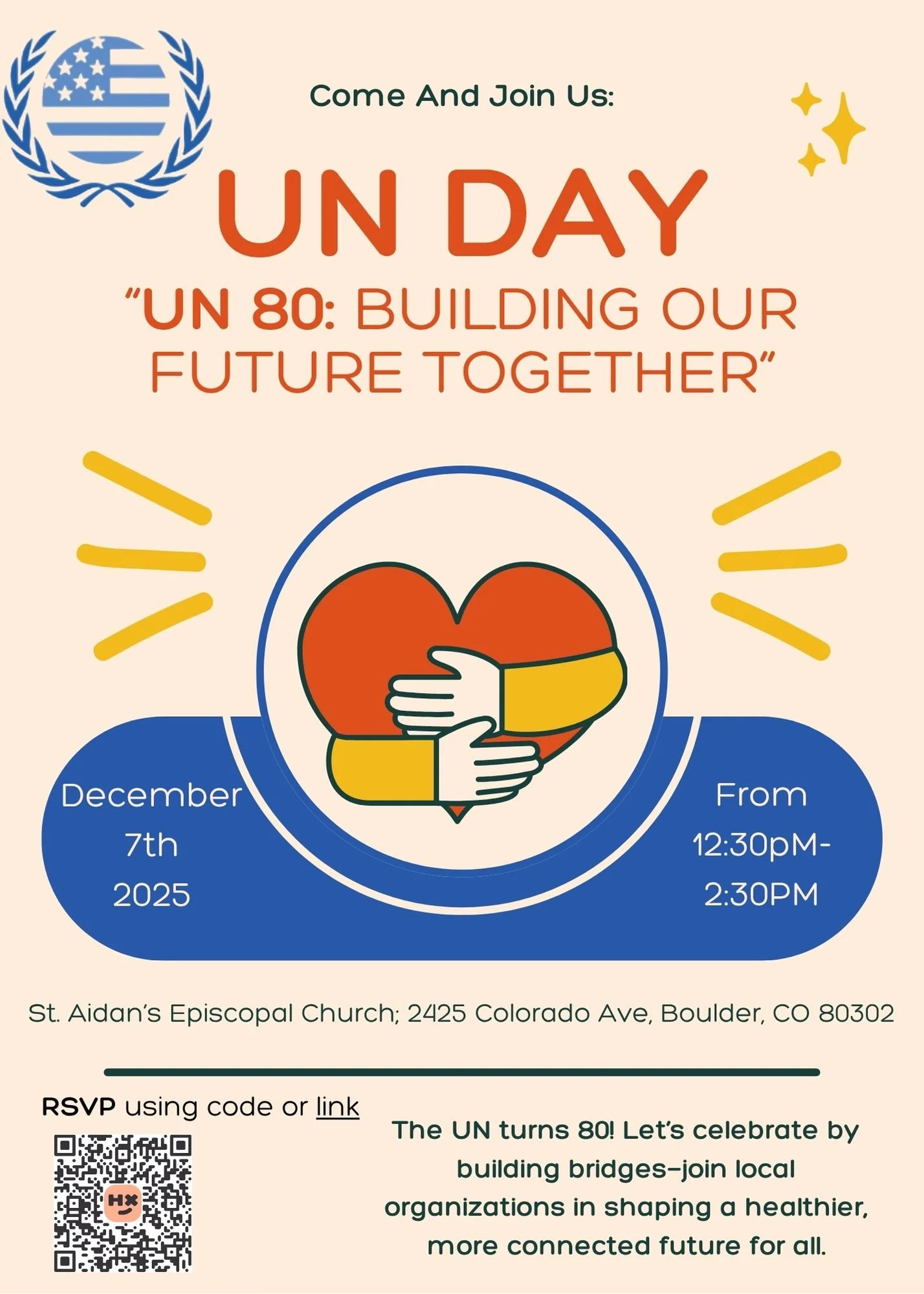
Our UN Day 2024 event, Mountain Strong Against Trafficking, brought together passionate advocates, experts, and community members at St. Aidan’s Episcopal Church in Boulder to address the pressing issue of human trafficking. The day was filled with powerful stories, insightful discussions, and a shared commitment to action.
From survivor testimonies to expert-led panels, the summit shed light on both the challenges and solutions in combating trafficking. Organizations like New Horizons House International, ALIGHT, and the Colorado Department of Public Safety provided invaluable resources, while speakers such as KC Wagner and AnnJanette Alejano-Steele shared their expertise on local and national anti-trafficking efforts.
The event concluded with a moving spoken word performance and a reflective discussion, leaving attendees with a renewed sense of purpose. Thank you to everyone who participated and supported this initiative—we are truly Mountain Strong in this fight!
On Tuesday, February 27, at the Boulder Public Library, Associate Professor Megan Shannon from CU Boulder led a thought-provoking discussion on “UN Peacekeeping in the Midst of War.” Drawing from her recent book and extensive research, Megan explored the complex role of UN peacekeeping missions in mitigating violence during civil wars.
Her presentation highlighted key findings from her work, which uses unique data to analyze how UN interventions impact ongoing conflicts. Through both large-scale quantitative studies and detailed case analyses, her research demonstrates that well-equipped and properly constituted UN peacekeeping missions can significantly reduce violence in war-torn regions.
With her background in international security and a recent Fulbright fellowship at the Peace Research Institute of Oslo, Megan provided an expert perspective on the effectiveness and challenges of UN peacekeeping efforts. Her talk sparked an engaging discussion on the broader implications of international intervention and the future of global peacekeeping initiatives.
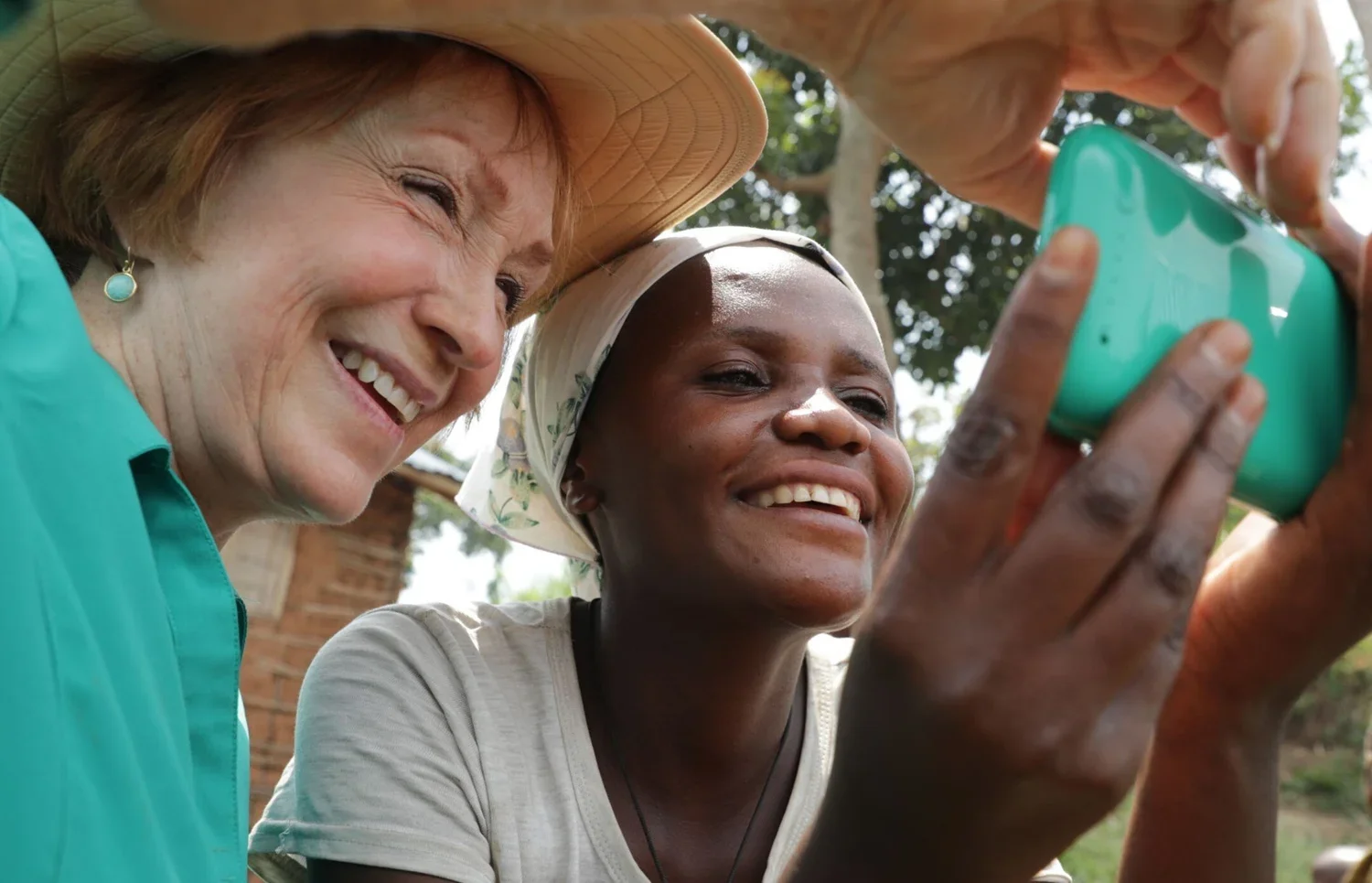
Professor Robert Wyrod led an insightful discussion on Global China and International Development: Perspectives from Sub-Saharan Africa at the Boulder Public Library on September 23. His presentation focused on China's expanding role as a development partner in Uganda, based on years of ethnographic research at Chinese-funded projects across the country. Wyrod explored the opportunities and challenges posed by Chinese investment, highlighting the complexities of economic growth, infrastructure development, and local impacts. His talk provided a thought-provoking analysis of China's global influence and its implications for African nations.
On April 16, the UNA-BC Discussion Series welcomed Dr. Gene Bolles, an esteemed neurosurgeon with decades of experience in both medical practice and humanitarian missions. In his talk, Geopolitical Aspects of Humanitarian Health Care Missions, Dr. Bolles shared firsthand accounts from his medical work in conflict zones, including Northern Iraq, North Korea, and China. Drawing from his extensive career, he explored the intersection of medicine, diplomacy, and global crises, highlighting the challenges and ethical dilemmas faced by medical professionals in politically sensitive regions. The discussion provided profound insights into the vital role of healthcare in international humanitarian efforts.
Why Rules-Based Orders Fail - by Ben Steil
For a brief period after the Cold War, Americans persuaded themselves that the liberal order had become self-sustaining. And yet, any rules-based system elaborate enough to govern and interpret its own operations will eventually confront questions that its rules cannot answer.
Originally published at Project Syndicate