Part One: What Really Happens When the World Comes to the United Nations?
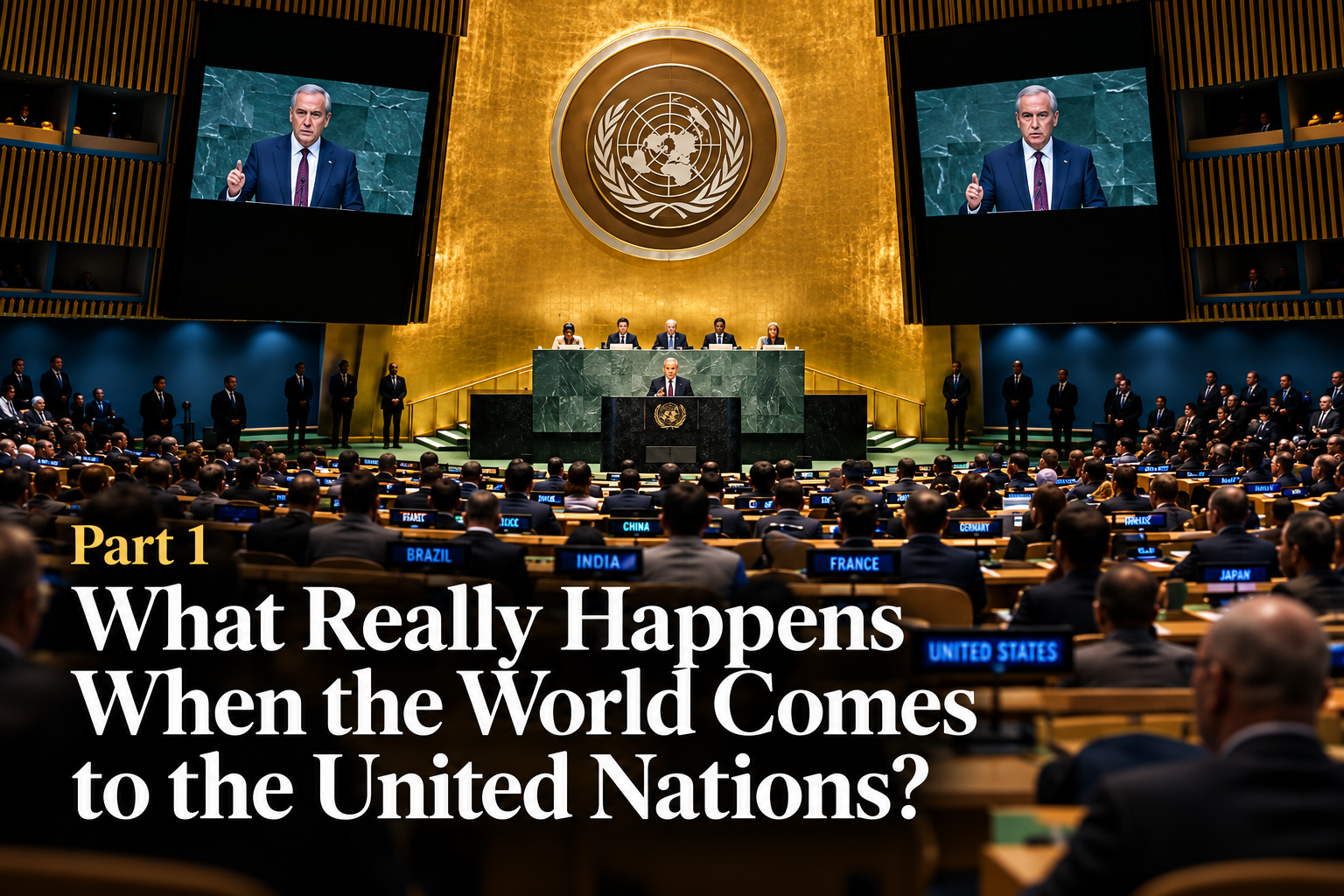
Every September, the television version of the United Nations General Assembly is fairly predictable. Presidents and prime ministers take turns speaking from the green marble podium. Allies applaud one another, adversaries trade accusations, delegations occasionally walk out, and journalists search for the sentence most likely to make the evening news. It can leave the impression that the annual gathering is essentially a week-long international speaking competition.
That misses much of what actually happens.
For several days each year, an extraordinary proportion of the world's political leadership is concentrated within a few square miles of Manhattan. Presidents, prime ministers, foreign ministers, diplomats, development banks, UN agencies, humanitarian organizations, business leaders and increasingly technology executives all arrive at roughly the same time. The result is less like a world parliament than an enormous diplomatic convention, with the General Assembly Hall providing the public stage while much of the practical work takes place elsewhere.
This matters because international diplomacy is normally cumbersome. A meeting between two foreign ministers can require weeks of preparation. A conversation between governments that barely maintain relations may require intermediaries, carefully negotiated language and agreement over where the meeting can even occur. During General Assembly week, many of those obstacles temporarily shrink. A minister can meet several counterparts in a single day. Governments that are publicly denouncing one another may still be exchanging proposals in adjoining buildings.
That was particularly visible during the 2026 General Assembly. While public attention concentrated on the United States and China, the war in Gaza, Israel's address and the continuing war in Ukraine, a quieter layer of diplomacy was unfolding underneath. American and Iranian officials reopened indirect contacts over the confrontation surrounding the Strait of Hormuz. US Secretary of State Marco Rubio met Russian Foreign Minister Sergei Lavrov. Germany's foreign minister also met Lavrov, restoring a senior-level bilateral channel that had effectively disappeared after Russia's full-scale invasion of Ukraine. Venezuela used the week to reopen conversations with international financial institutions, while Sudanese ceasefire proposals were being discussed and contested.
None of this produced a dramatic peace agreement, but that is not necessarily the right standard by which to judge the week. Diplomacy rarely moves in cinematic breakthroughs. More often it advances through partial agreements, restored communication, tentative proposals and the discovery of what the other side will or will not accept. In some circumstances, simply restoring the ability to talk is significant.
The UN General Assembly also gives smaller countries something they rarely receive elsewhere: the same formal platform as the major powers. A Pacific island state facing sea-level rise can speak from the same podium as the United States or China. An African state can press for Security Council reform before the entire membership. Governments that would struggle to command global attention individually can organize collectively and force issues onto the international agenda.
This is one of the reasons the annual gathering remains important even when the UN appears unable to resolve the wars dominating the headlines. The organization is not only a place where resolutions are passed. It is also infrastructure for diplomacy. It provides rooms, protocols, translators, negotiators, neutral meeting space and, perhaps most importantly, an accepted reason for nearly everybody to show up at the same time.
The public speeches still matter. They place national positions on the historical record and allow governments to signal priorities and red lines. But when we judge General Assembly week solely by the speeches, we are watching only the most visible layer of a much larger event.
The podium is where governments tell the world what they want us to hear. The corridors around it are where they begin discovering what may actually be possible.