Part Two: The UN Stories We Missed While Watching the Big Speeches
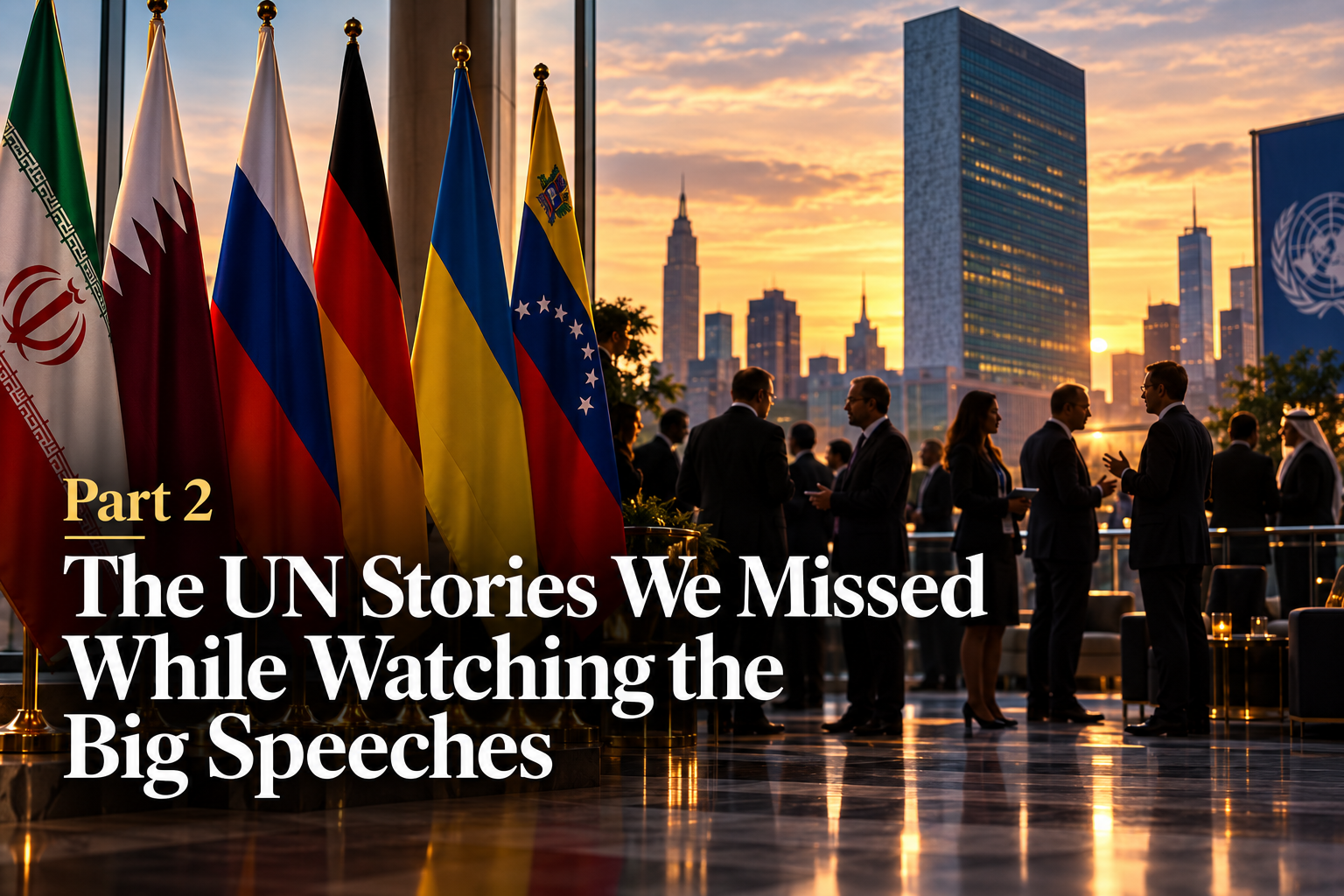
The largest stories from this year's United Nations General Assembly were easy to identify. The relationship between the United States and China dominated one part of the coverage. Israel, Gaza and the wider Middle East dominated another. Russia's war in Ukraine remained a constant backdrop. Yet some of the week's most consequential diplomatic activity received far less attention because it lacked the drama of a confrontation at the podium.
Iran was one example. During General Assembly week, American and Iranian officials resumed indirect diplomatic contacts over the crisis surrounding the Strait of Hormuz. Qatar again played an intermediary role, and Iranian proposals reportedly addressed both the reopening of the Strait and the US maritime blockade. No settlement emerged, but the fact that the negotiating channel reopened was important in itself. Hormuz is not simply a regional issue: disruption there can affect global energy supplies, shipping costs and economic confidence far beyond the Middle East.
Ukraine produced another potentially important development. Following discussions involving US Secretary of State Marco Rubio and Russian Foreign Minister Sergei Lavrov, Rubio said that both Russia and Ukraine had shown interest in exploring a narrower arrangement protecting grain shipments and energy infrastructure. Such an agreement would fall far short of a ceasefire, much less a peace settlement, but limited agreements can matter. Reducing attacks on power networks could protect civilians, while greater security for Black Sea trade could ease pressure on food markets in countries thousands of miles from the battlefield.
Germany also reopened direct ministerial contact with Moscow. German Foreign Minister Johann Wadephul met Lavrov in New York, the first bilateral meeting at that level since before Russia's full-scale invasion. Germany did not abandon its support for Ukraine, nor did the meeting imply normalization with Russia. The importance lay in the restoration of communication. Diplomatic channels are most valuable precisely when relations are bad.
Venezuela provided a different example of what normalization looks like. Delcy Rodríguez met political and financial leaders as Caracas continued a tentative return toward the international economic system. Discussions included Venezuela's enormous unresolved sovereign debt, and IMF Managing Director Kristalina Georgieva also met Rodríguez during the week. The IMF has since explored establishing a presence in Venezuela.
These developments may sound less dramatic than a presidential speech, but they represent the practical mechanics of rebuilding a country's relationship with the world economy. Political isolation eventually becomes a question of debt restructuring, access to international capital, reliable national statistics, investment, currency management and relations with institutions such as the IMF and World Bank.
Sudan demonstrated the more frustrating side of diplomacy. The United States promoted a proposal for a 90-day ceasefire followed by political negotiations, but Sudan's army leadership objected to major elements of the plan. Its representatives argued that the proposal could legitimize the rival Rapid Support Forces and potentially entrench the country's fragmentation. No breakthrough followed, but even failed negotiations reveal something useful: they establish where the parties' actual red lines lie and what any future settlement will have to overcome.
Beyond the wars, smaller states were also pushing issues that rarely receive equivalent media attention. Governments advanced a political declaration on sea-level rise, increasingly treating it not simply as an environmental problem but as an issue involving finance, development, migration, national security and international law. For small island countries, the implications are profound. What happens to maritime boundaries if coastlines retreat? What happens to citizenship if an entire population is forced to relocate? Can a state continue to exist legally if much of its territory becomes uninhabitable?
Pandemic preparedness also returned to the agenda. Governments continued working through questions that COVID-19 exposed but never resolved: how quickly countries should share information about new pathogens, who receives vaccines and medicines during a global emergency, how preparedness is financed and how much authority international institutions should possess during an outbreak.
This is the side of the United Nations that is easy to overlook. Much of its work is procedural, slow and deeply unglamorous. It involves technical agreements, preliminary talks, draft language and negotiations that may require years before producing visible results.
Yet that is often how international order is built. The important question after General Assembly week is therefore not simply, "Which speech made the most news?" It is also, "Which conversations began that did not exist the week before?"