
Beyond the Hype — Why Humanitarian Engineering and Human-Centered Design Must Lead the AI Era
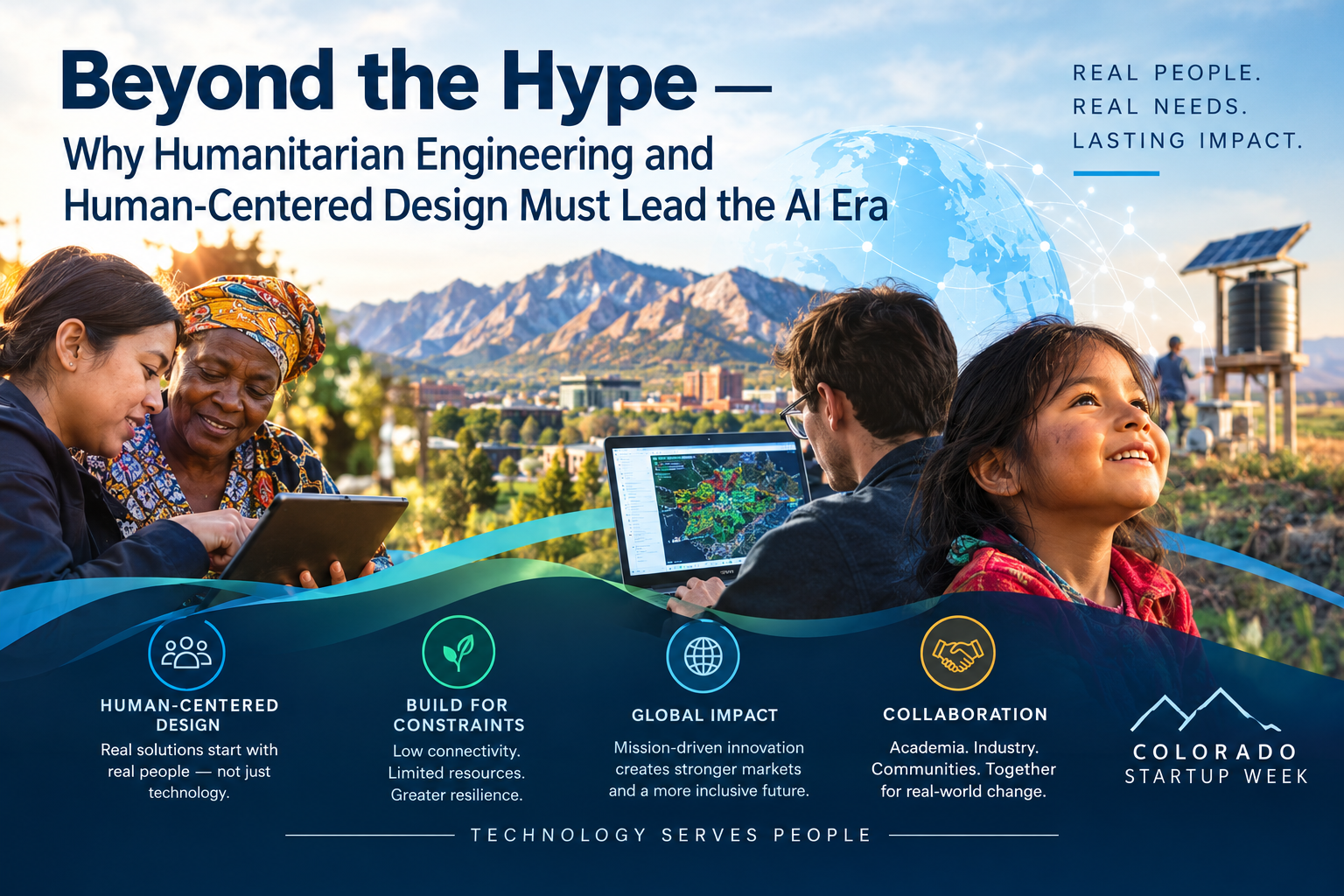
By Vik Gopalan: At a recent panel session during Colorado Startup Week, leaders from academia, corporate strategy, and global technology gathered to discuss how innovation intersects with the developing world. While artificial intelligence and advanced technologies dominate headlines, the core takeaway from the discussion was clear: technology is only as effective as the human systems it serves.
Why Should You Care About This?
Whether you're a founder scaling a company in Denver, an engineer coding in Boulder, or an investor allocating capital across the Front Range, it’s easy to feel overwhelmed by today’s AI hype cycle. But innovation isn't just about build speed—it's about real-world impact. Colorado has quietly become a premier hub for global development practitioners, human-centered engineers, and mission-driven technologists. Understanding how to build for extreme constraints, low-connectivity environments, and vulnerable populations doesn't just make your technology more resilient—it opens up massive global markets and ensures the systems we build today solve century-scale challenges rather than creating new digital divides.
De-Centering Technology and Prioritizing Human Realities
Technology is just a tool: True systemic change requires designing solutions that can be utilized by the populations most vulnerable to macro challenges, rather than just those who are ready for immediate adoption.
Putting humans first: Professor Juan Lucena of the Colorado School of Mines noted that technologies often legislate lives and constrain what is possible, making it vital to de-center technology and prioritize human communities.
Recognizing digital and physical blind spots: Lucena shared insights from working with informal sectors like street recyclers in Medellín, Colombia, illustrating that AI search tools fail to capture the complex emotional, tactile, and manual intelligence required in environments with vast power differentials and missing digital footprints.
Starting with research: Professor Abbott stressed that every technical intervention must begin with rigorous research and an understanding of existing community ecosystems, local power structures, and how problems are already being managed.
Falling in Love with the Problem, Not the Tech
Understanding constraints: Panelists from Google highlighted that building successful products requires falling in love with the user's problem rather than the technology itself.
Practical deployment models: Vivek of Google DeepMind cited examples such as partnering with local NGOs to distribute flood forecasting data and delivering rainfall models to farmers in India via SMS text messages to bypass smartphone and data plan limitations.
Interwoven go-to-market strategies: Julia Gil of Google emphasized that technical development and go-to-market strategies must be integrated early, ensuring that assumptions about intermittent connectivity, timing, and end-user value are thoroughly documented and tested.
Stay tuned for Part 2 in December, where we explore the macro-level view: overcoming the tyranny of short-termism, closing the $4 trillion SDG financing gap, and the future of sustainable impact investing.
