Part Three: Building the United Nations We Need — A Reform Agenda Worth Supporting
Reform should not simply make the UN smaller. It should make the institution better at keeping peace, protecting people and bringing nations together.
What would a successful United Nations look like ten years from now? Would we judge it by the number of employees it has, the size of its budget or the number of resolutions passed in New York? Or would we judge it by something more meaningful: conflicts prevented, lives protected, international agreements upheld and countries better able to resolve their differences peacefully?
This is the question that should guide the current debate about reform.
The UN is facing financial pressure, changing expectations from member states and growing public demands for accountability. The response should not be simply to defend existing arrangements or reduce expenditure wherever possible. It should be to reconsider how the institution can best achieve the purposes established in its Charter.
There is already an opportunity to do this through the UN80 reform initiative. The challenge is ensuring that administrative improvements lead to a stronger institution rather than merely a less expensive one.
UN80: More than a cost-cutting exercise
Secretary-General António Guterres launched UN80 to address three related problems: how the UN operates, how the mandates assigned by governments are managed, and how the wider UN system is organized.
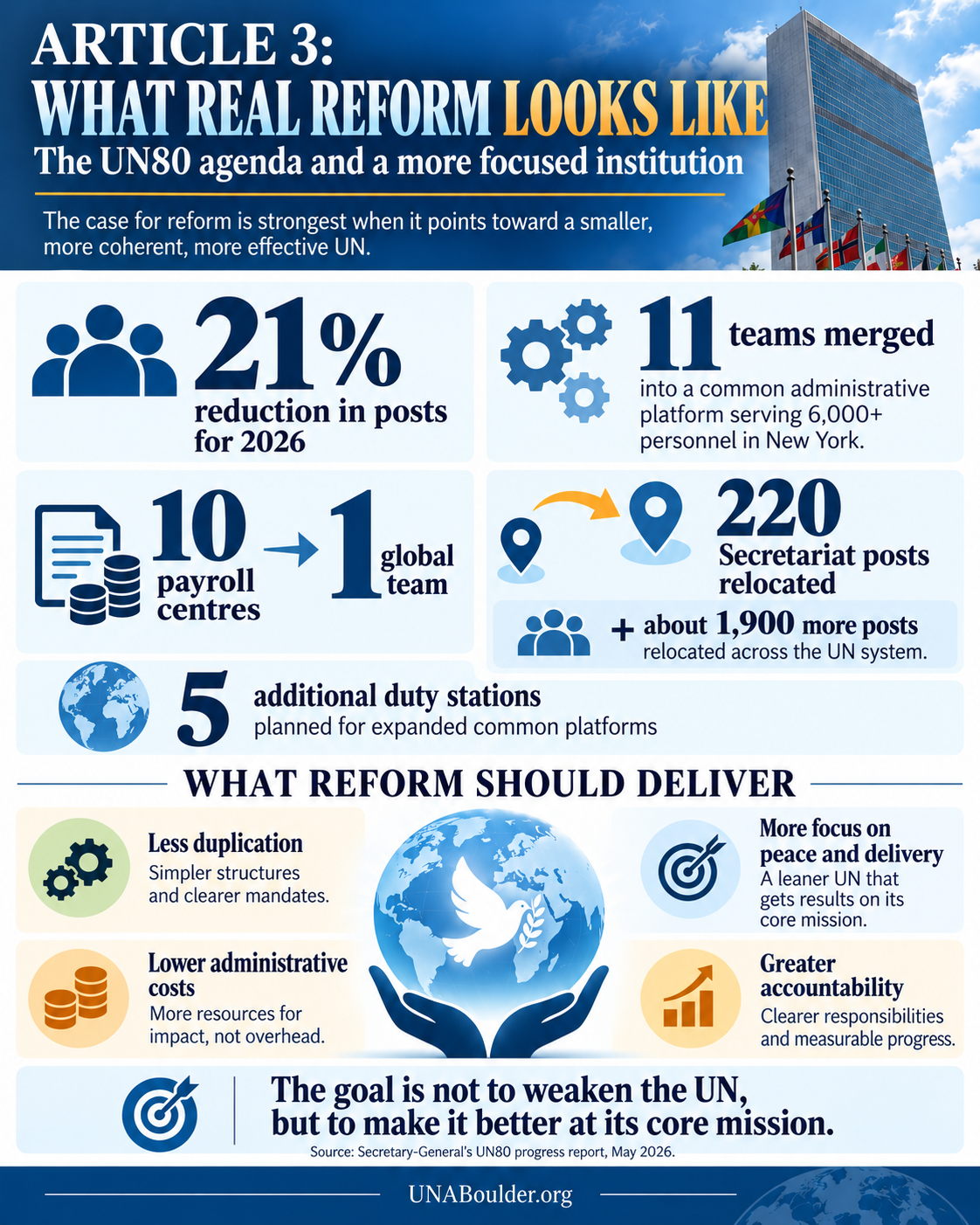
The initial changes are substantial. The Secretary-General reported a 21% reduction in Secretariat posts for 2026. Eleven administrative teams have been consolidated into a common platform serving roughly 6,000 personnel in New York, with expansion to other duty stations planned. Ten payroll centers have become one global team, while functions are being relocated from expensive locations where appropriate.
These may sound like ordinary management improvements, and in some respects they are. But that is precisely the point. International institutions should be expected to adopt the same sensible administrative practices that governments, businesses and nonprofit organizations use to improve efficiency.
UN80 also goes beyond the Secretariat. Its agenda includes reviewing overlapping mandates, improving humanitarian supply chains, coordinating development assistance, strengthening cooperation on human rights and reconsidering how peace operations should respond to modern conflicts.
These broader changes are likely to matter more than the initial staffing reductions. They offer an opportunity to rethink how the UN delivers services, cooperates internally and supports the governments and communities it serves.
Put peace and conflict prevention first
The UN was created in the aftermath of two world wars. Its founders understood that military power alone could not provide a lasting international order. Nations needed institutions through which they could negotiate, resolve disputes, establish common standards and cooperate despite their differences.
Peace and security must remain central to that vision. But preventing conflict involves more than deploying peacekeepers after violence begins. It requires early warning, mediation, diplomacy, respect for international law and efforts to address the conditions that allow violence to return.
In the current debate about international funding, it is worth remembering that conflict prevention may be among the most economical activities an international organization can undertake. Effective mediation or a modest peacebuilding initiative can sometimes avert humanitarian emergencies and military operations costing vastly more.
The United States and other governments are entitled to question whether particular programmes are performing effectively. But decisions about reducing or ending support should include an assessment of the consequences for conflict prevention and the protection of civilians.
A return to the UN's founding mission should strengthen these capabilities, not weaken them.
Make accountability part of everyday operations
Reform must also address the institutional weaknesses that have damaged the UN's reputation. Every major programme should have clear objectives, transparent budgets, independent evaluation and credible mechanisms for investigating misconduct.
The existing Office of Internal Oversight Services and other independent accountability bodies provide important foundations. Their findings should be more accessible, their recommendations tracked, and responsible managers expected to explain what corrective action has been taken.
Peacekeeping missions deserve particular attention. Governments that contribute military and police personnel must ensure that allegations of serious misconduct are properly investigated and, where appropriate, prosecuted. Victims must have access to meaningful support. Protecting the reputation of an institution must never take precedence over protecting the people it serves.
A stronger culture of accountability would not only reduce waste and misconduct. It would also make it easier for member states and the public to support programmes that demonstrate genuine results.
Make international cooperation easier, not more complicated
The UN's greatest strength is its ability to bring countries together around problems that no nation can solve alone. Yet its complex structure can sometimes make that cooperation unnecessarily difficult.
Imagine a humanitarian emergency in which UN agencies share logistics, procurement information and essential administrative services rather than maintaining parallel systems. Imagine country teams with clearer leadership, fewer overlapping reporting requirements and greater authority to respond to local circumstances. Imagine development programmes that build lasting local capacity rather than perpetuating dependence on international organizations.
These are the kinds of practical improvements that UN80 should deliver.
Reducing duplication is not about diminishing the work of international agencies. It is about allowing skilled professionals to spend more time on the work they were hired to do and less time managing fragmented institutional processes.
Success should be measured through delivery times, financial transparency, improved local capacity and the outcomes achieved for communities.
Member states must also reform their behavior
There is a limit to what the Secretary-General can accomplish without changes in the conduct of governments.
The Security Council's structure reflects the geopolitical settlement of 1945. Its permanent members retain veto powers that can prevent effective collective action. Reform proposals have circulated for decades, but progress remains difficult because meaningful change requires agreement among the very governments whose privileges are at issue.
The problem deserves continued attention. There may be opportunities to improve transparency, increase the representation of underrepresented regions, strengthen voluntary restraint in the use of the veto during mass atrocities and provide the General Assembly with a stronger role when the Security Council is paralyzed.
Equally important, all member states should honor their financial commitments. A system in which governments authorize programmes but fail to provide their assessed contributions cannot operate predictably.
International organizations should be accountable to their members. Member states, in turn, must be accountable for the commitments they make through those organizations.
A constructive role for the United States
The United States played a leading role in the creation of the United Nations, including the drafting of its Charter in San Francisco. That history gives Americans a particular reason to participate seriously in discussions about its future.
The current administration has placed considerable emphasis on efficiency, national sovereignty and the need for international organizations to demonstrate their value. These are legitimate subjects for public policy debate. Its decisions to reduce funding and withdraw from particular institutions have also raised substantial concerns about operational capacity, international cooperation and the ability of the United States to shape global rules.
These policies should be evaluated by their actual effects. Where American proposals produce greater transparency, effective consolidation or stronger oversight, those improvements should be recognized. Where reduced participation undermines essential international functions, the consequences should be examined with equal care.
The same standards should apply to every administration and every member state.
The most constructive approach is to combine rigorous scrutiny with continued engagement. International institutions become stronger when governments participate in shaping their priorities, contribute to their success and insist upon credible results.
What should we demand from a stronger UN?
The reform agenda deserves public support, but it also needs meaningful measures of success. We should look beyond how many offices close or how much expenditure is reduced and ask whether the organization is doing its job better.
Are peacekeeping missions protecting civilians more effectively? Are mediation efforts preventing conflicts from escalating? Is humanitarian assistance reaching vulnerable populations faster? Are more audit recommendations being implemented? Are international programmes building stronger local institutions? Are governments cooperating more effectively to address shared problems?
These are the measures that would help demonstrate whether reform is working.
A successful UN80 initiative would leave the institution with clearer responsibilities, more reliable funding, stronger accountability and greater capacity to act where international cooperation is indispensable.
Our responsibility as supporters of the United Nations
At UNA Boulder County, we support the purposes and principles of the United Nations Charter. Our commitment is not to any particular government, political party or administrative arrangement. It is to the conviction that nations must have effective institutions through which they can cooperate, resolve disputes and protect human dignity.
That commitment leaves ample room for criticism, vigorous debate and institutional change. Indeed, it requires them.
The United Nations has survived for eight decades because the need for international cooperation has endured through changing political circumstances. Its future will depend not upon resistance to reform but upon the willingness of governments, international officials and citizens to make it work better.
We should welcome reforms that strengthen the institution, question those that undermine its mission and insist that every change be judged against the purposes of the Charter.
The goal is not merely a smaller United Nations. It is a more capable United Nations: one that earns trust through accountability, strengthens peace through cooperation and remains worthy of the hopes placed in it in 1945.