Part Two: Accountability Is Essential to Trust — Why UN Reform Cannot Wait
The United Nations has achieved remarkable things. Its failures deserve equally serious attention.
Supporting the United Nations should never require us to overlook its mistakes. Quite the opposite. An organization entrusted with protecting vulnerable people, preventing conflict and upholding international standards should be held to exceptionally high standards of conduct and accountability.
Over eight decades, the UN system has helped eradicate disease, support countries emerging from war, coordinate disaster relief, and establish rules that allow nations to cooperate peacefully. These achievements are substantial. Yet the institution has also experienced serious failures involving financial oversight, peacekeeper misconduct, weak management and political paralysis.
Acknowledging these problems is not an argument against the UN. It is an essential part of ensuring that the organization can continue to fulfill its mission.
What the UN's own auditors have found
Some of the clearest evidence for reform comes from the UN's Office of Internal Oversight Services (OIOS), whose responsibility is to investigate misconduct and identify weaknesses in the organization's operations.
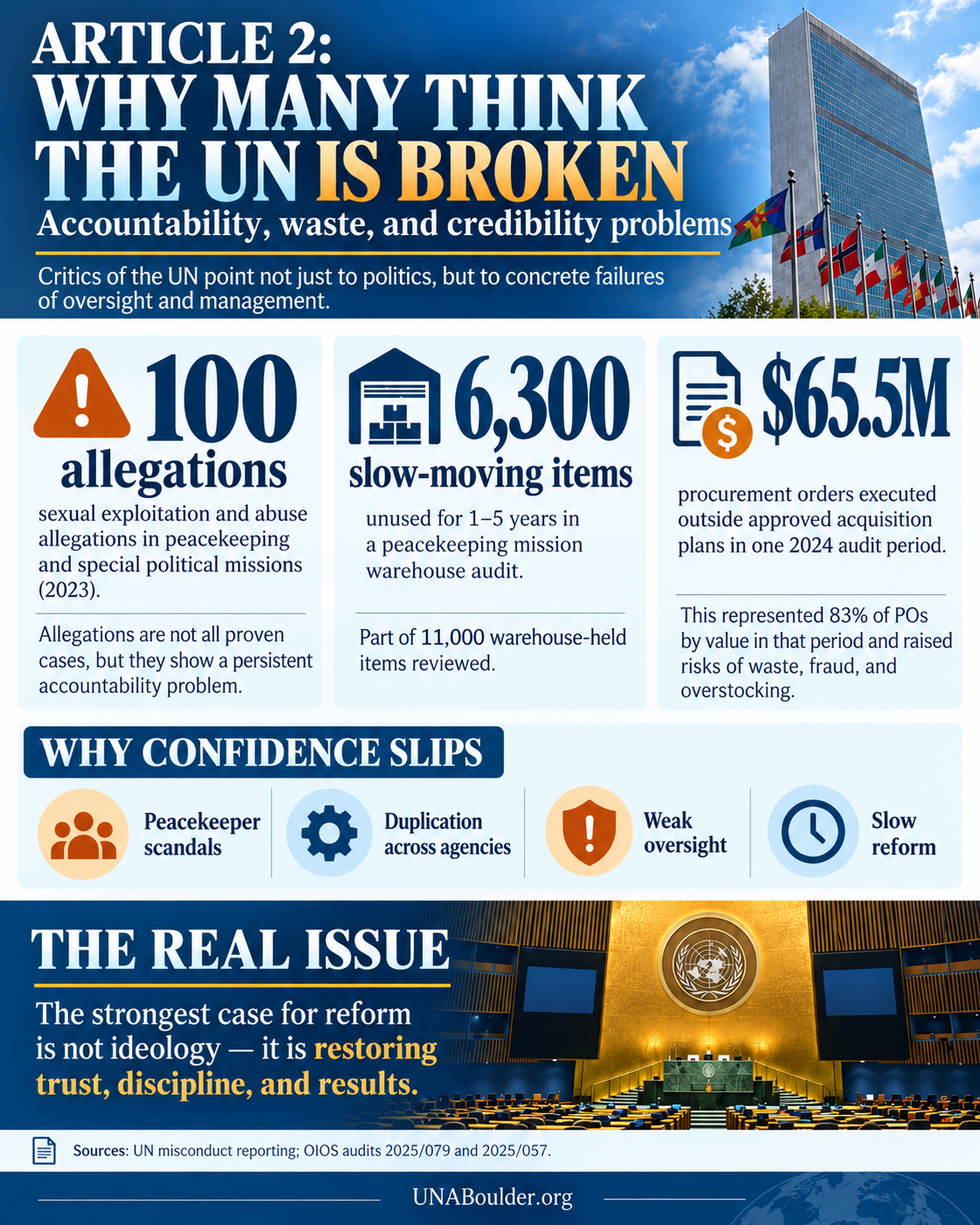
A 2025 audit of a peacekeeping operation examined approximately 11,000 items held in warehouses, with a net book value of $14.5 million. Of these, some 6,300 items, or 57%, had remained unused for between one and five years. Auditors raised concerns about overstocking, inefficient use of resources and the risk that equipment would eventually have to be disposed of during the mission's downsizing.
Peacekeeping operations must maintain reserves for emergencies, and unused equipment is not automatically waste. Nevertheless, stock levels should be justified by operational requirements. Warehouses full of poorly managed supplies represent resources that might otherwise be available for essential operations.
Another 2025 audit found that procurement and stock transfer orders valued at $65.5 million had been executed outside approved acquisition plans during the final six months of 2024. This represented 83% of the value of the orders examined for that period. It does not mean that $65.5 million disappeared or was spent fraudulently. It does mean that established financial planning controls were not functioning as intended.
These are specific, documented management problems. They demand corrective action, better forecasting, stronger procurement controls and more transparent follow-up.
There is also something encouraging in these findings: the UN's own oversight institutions identified and reported them. The next challenge is ensuring that recommendations lead to lasting improvements rather than another cycle of audits and promises.
When misconduct undermines the mission
Financial inefficiency is troubling, but misconduct involving vulnerable people is far more serious.
Sexual exploitation and abuse involving personnel associated with UN peacekeeping missions has repeatedly damaged public confidence. UN peacekeeping reporting documented 98 allegations of sexual exploitation and abuse during 2023, alongside hundreds of allegations of other serious misconduct. Allegations are not necessarily substantiated, and they must be investigated fairly, but the persistence of these cases demands sustained attention.
Peacekeepers are deployed to help protect people whose lives have already been disrupted by violence, displacement and insecurity. Abuse of that responsibility betrays both the victims and the ideals represented by the blue helmet.
Accountability is complicated by the fact that military peacekeepers remain subject to the jurisdiction of their troop-contributing countries. The UN can repatriate personnel and press for investigations, but criminal prosecution often depends on national authorities. Stronger reporting, victim assistance, independent investigations and reliable action by troop-contributing governments must therefore remain priorities.
The cholera epidemic in Haiti offers another painful lesson. Scientific investigations linked the introduction of cholera to a UN peacekeeping operation, and the UN's response to the resulting crisis and questions of responsibility was widely criticized. Thousands died. The episode showed how operational failures and institutional reluctance to accept accountability can cause lasting damage to public trust.
These failures must neither be minimized nor used to dismiss the many peacekeepers who have served courageously and honorably, sometimes at the cost of their lives.
Is the UN system too complicated?
The UN has grown far beyond the relatively compact organization created in 1945. Its wider system includes specialized agencies, programmes, funds, commissions, regional offices and numerous coordinating bodies. Each has developed its own history, constituencies and administrative arrangements.
Much of this complexity reflects genuine international needs. Refugee protection, public health, food assistance, civil aviation and telecommunications all require specialist expertise. Some activities that appear similar on paper also serve different populations or legal responsibilities.
Still, there are legitimate questions about whether every organization requires its own administrative systems, management structures, procurement procedures and reporting arrangements. The UN80 initiative is beginning to address these issues through shared services, consolidated administration and reviews of longstanding mandates.
This is a sensible direction. Money spent unnecessarily on duplicated administration is money that cannot be spent delivering assistance, supporting mediation or protecting civilians.
But cost reductions need to be evaluated carefully. Closing an office may produce an immediate saving while reducing the organization's ability to operate effectively in a crisis. Merging programmes can improve coordination, but poorly designed consolidation can also weaken specialist expertise.
The objective must be measurable improvements in performance, not administrative change for its own sake.
The responsibility of member states
Not every UN failure can be attributed to its employees or management.
The Security Council remains constrained by the competing interests of its five permanent members. The veto has repeatedly prevented collective action on major conflicts, including those involving permanent members or their close allies. This problem cannot be solved by reducing the Secretariat's payroll.
Governments also contribute to institutional difficulties by negotiating overlapping mandates, demanding new programmes without providing adequate funding, and applying international principles inconsistently.
Member states are both the UN's greatest source of authority and, at times, its greatest obstacle. They cannot reasonably demand better performance while denying the organization the political support, resources or cooperation needed to fulfill the mandates they have established.
This is why reform must be a shared undertaking between the Secretariat and the governments that direct it.
What success looks like
There are encouraging examples of UN operations achieving their objectives. In Liberia, a peacekeeping mission supported the country's recovery from civil war, helped strengthen national institutions and assisted successive elections before completing its mandate in 2018. The transition of responsibilities back to Liberian institutions was a significant achievement.
That experience illustrates the kind of results we should want from international engagement: clearly defined responsibilities, stronger national institutions, sustained peace and, eventually, the ability for international personnel to leave.
A culture of accountability should reinforce these successes. Financial controls should be stronger, misconduct should face meaningful consequences, and programmes should be evaluated by their outcomes rather than their budgets or institutional longevity.
At UNA Boulder County, we believe confidence in the United Nations is built through both principle and performance. The Charter gives the institution its purpose, but responsible management and credible results sustain public trust.
Supporting the UN means celebrating its achievements, confronting its failures and insisting that lessons learned produce meaningful change.
That is not criticism from outside its mission. It is a commitment to making the mission succeed.