You’re Invited: The Next Nuclear Age: Four Ways of Looking at the Future of Nuclear Energy. Friday, September 25 | 1:30 – 3:00 PM - Boulder Library
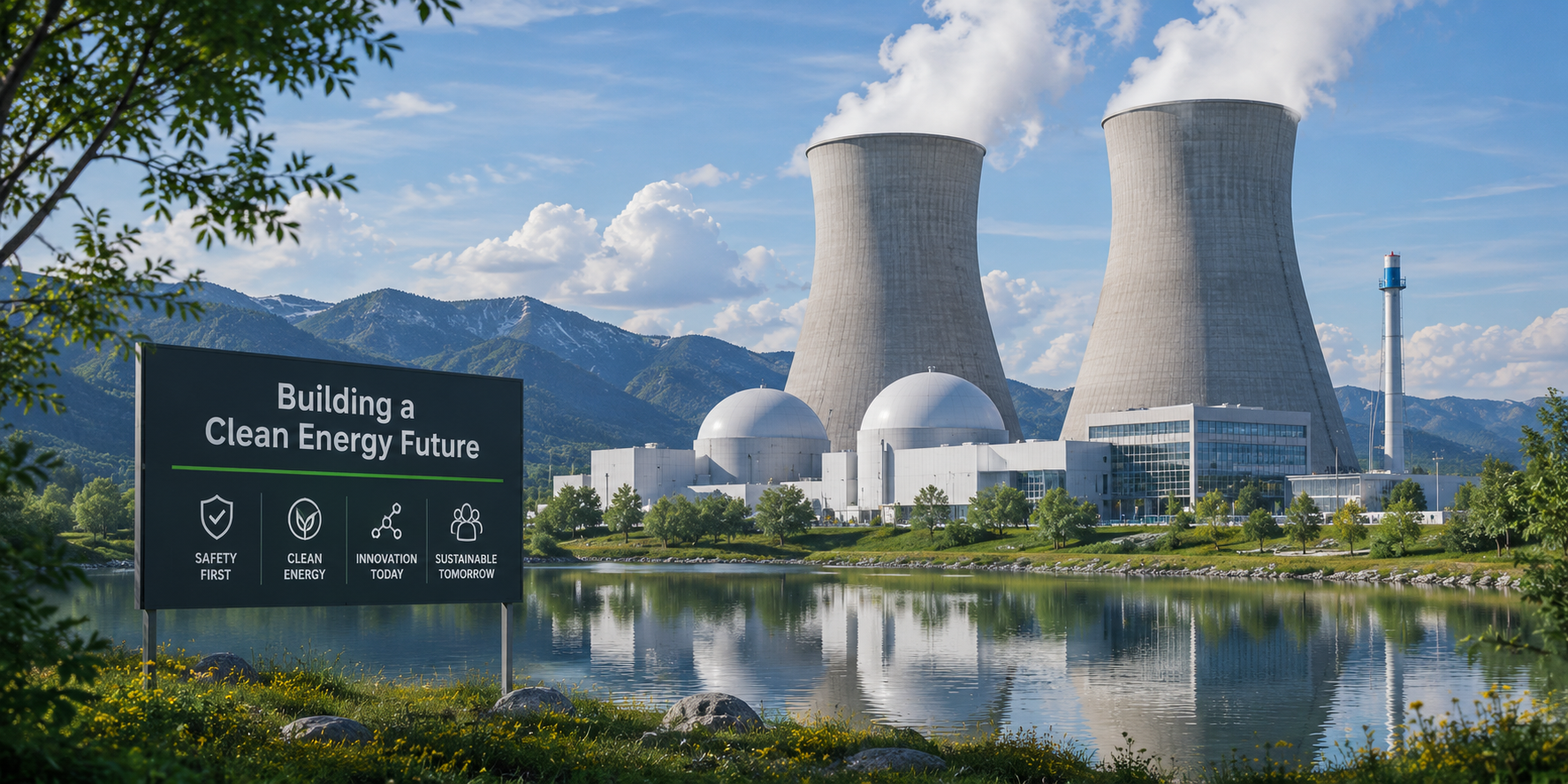
What happens when a technology once regarded as yesterday's answer becomes a potential answer to tomorrow's problem?
Nuclear energy is back in the conversation. For much of the past several decades, nuclear power in the United States and many Western countries was defined by a familiar set of questions: How safe are reactors? What happens when something goes wrong? What do we do with highly radioactive waste? How much does a nuclear plant cost? And can governments and the public ever fully trust the technology?
Those questions have not disappeared but the circumstances surrounding them are changing.
Electricity demand is accelerating because of artificial intelligence, data centers, industrial electrification, electric cars and the broader digital economy. At the same time, countries are looking for reliable electricity sources that can operate around the clock while reducing carbon emissions. The result is a renewed interest in nuclear power. Not necessarily a return to the nuclear industry of the 1970s, but an attempt to imagine something different.
Small modular reactors. Advanced reactors. Molten-salt systems. New fuel cycles. Passive safety systems. Factory manufacturing. Smaller and potentially more distributed plants.
The question for our upcoming UNA discussion is therefore not simply "Are you for or against nuclear power?"
It is much more interesting:
Has nuclear technology changed enough that we need to reconsider the assumptions on which the nuclear debate has traditionally been based?
And even if the technology has changed, have the economic, political and social problems changed with it? That is where our three panelists come from very different directions.
Register Here
Four Panelists — Four Different Nuclear Questions
The most interesting feature of this discussion may be the tension between the panelists' perspectives.
Tim Oakes: Nuclear Power Is More Than a Technology
Professor Tim Oakes' work approaches nuclear energy through what is sometimes called a sociotechnical perspective. That distinction matters. The conventional nuclear debate tends to be highly technical. Engineers calculate reactor failure probabilities. Economists calculate construction, running and decommissioning costs. Regulators establish safety requirements. Governments determine energy policy.
Oakes' research asks us to step back and consider something more complicated: technology does not exist independently of the societies that build, regulate and live alongside it.
His current work, Living in Nuclear Asia: Sociotechnical Perspectives on Nuclear Power Development, Risk, and Vulnerability, compares the experiences of Japan and China. His research program has examined not only reactor technology but also the political, cultural and social relationships that develop around nuclear infrastructure. This makes the Japanese and Chinese comparison particularly revealing;
Japan possessed sophisticated technology, highly developed institutions and a powerful nuclear industry. Yet Fukushima demonstrated that technological sophistication does not eliminate systemic vulnerability.
China has taken a dramatically different path, expanding nuclear power as part of a broader infrastructure-driven development strategy while operating within a distinctly different political and institutional environment. Oakes' work asks what happens when nuclear technology becomes embedded in different societies, governments and cultures.
That creates an important challenge to the more technologically optimistic argument:
A safer reactor may not automatically produce a safer nuclear system.
There is still the question of who operates it, who regulates it, where it is located, how communities perceive it, how emergency systems work and who accepts responsibility when something goes wrong. In other words, Oakes' question is less:
Can we build a safer reactor?
and more:
What kind of society do we create around the reactor?
Robert McNown: Can Nuclear Actually Compete?
Robert McNown approaches the issue from a very different direction. As an economist, his central question is much less about whether a technology can theoretically work and much more about whether it makes economic sense. That is an increasingly important question.
The nuclear industry has historically faced a fundamental contradiction. Nuclear plants can produce enormous amounts of reliable electricity for decades, but building them has often required enormous upfront capital investment, long construction periods and complex regulatory processes.
The economic case therefore depends on the entire lifecycle of the plant — financing, construction, operation, maintenance, fuel, decommissioning and waste. And this is where the current energy environment gets interesting. Electricity demand from data centers and artificial intelligence is changing the calculation. Nuclear plants are attractive to large electricity consumers because they can provide continuous power rather than relying entirely on intermittent generation and storage.
But that does not automatically make nuclear economical. The latest generation of SMRs is still commercially immature. The United Nations University notes that SMRs could provide reliable low-carbon electricity, heat, desalination and hydrogen, but identifies cost, waste, safety and equity as unresolved questions.
A 2026 review of U.S. SMR designs similarly found substantial uncertainty surrounding both electricity costs and waste generation. Some SMR designs may actually produce more waste per unit of electricity than large reactors, depending on the technology. That gives McNown's economic perspective an important role. The question is not whether SMRs are exciting but instead:
Can they produce electricity at a price that customers will actually pay?
Alan Taddiken: Can Nuclear Be Governed?
Alan Taddiken brings another perspective — one grounded in public policy, economic development and his experience analyzing nuclear facilities in New York State. This introduces perhaps the hardest question of all;
Even if an advanced reactor is technically safer and potentially economical, what regulatory system should govern it?
Traditional nuclear regulation developed around large, centralized reactors while emerging technologies are increasingly different. A future nuclear system might contain dozens or hundreds of smaller reactors manufactured in factories and transported to sites. Some could potentially be located near industrial facilities. Others might provide electricity or heat to remote communities. Some advanced systems could use different fuels and coolants from today's conventional reactors.
The regulatory challenge therefore becomes much larger than simply approving a reactor design. Governments must determine:
Where can these reactors be built?
Who regulates them?
How are emergency zones determined?
How is nuclear material transported?
Who is responsible for spent fuel?
What happens if a reactor manufacturer fails financially?
How are communities compensated for risk?
How should national security considerations be incorporated?
How should regulators compare nuclear risks with the risks of alternative energy systems?
This is where the panel's perspectives are likely to collide. A technology advocate might say:
"The new reactors are fundamentally safer."
A regulator might respond:
"That doesn't mean the regulatory system can assume they are safe."
An economist might ask:
"And who pays for the regulatory system?"
A sociotechnical researcher might add:
"And what happens when the public doesn't believe any of you?"
We are therefore set for a more interesting nuclear debate than simply arguing over whether reactors are dangerous.
Daryl Wallace: Can The Future Nuclear Technologies Be Governed Differently?
Daryl Wallace brings a forward-looking perspective on emerging nuclear technologies, with particular interest in small modular reactors (SMRs), thorium molten-salt systems, and the South Korean nuclear model. He views these developments as potentially significant departures from the conventional nuclear model, particularly in their approach to safety, manufacturing and fuel cycles.
Daryl is particularly interested in the potential of molten-salt and thorium technologies to improve passive safety while potentially reducing some of the long-lived waste associated with conventional nuclear fuel cycles. He also sees SMRs as an opportunity to shift nuclear construction from large, bespoke projects toward standardized, factory-based manufacturing. South Korea's experience, in his view, offers an important example of how sustained investment in engineering, manufacturing, supply chains and standardized reactor technology can make nuclear development more efficient and internationally competitive.
His perspective will focus on whether these emerging technologies can address some of nuclear power's longstanding challenges and whether they represent a genuinely new generation of nuclear energy or simply a more advanced version of the existing model.
The Real Conflict: Technology vs. Institutions vs. Economics
This is ultimately why the panel will be interesting. The disagreement may not be over whether nuclear power produces risks. Everyone can agree that it does. The deeper disagreement is over;
What determines whether those risks are acceptable?
The technological argument
The advanced-nuclear perspective says:
The old nuclear debate is increasingly based on yesterday's technology.
If reactors can be smaller, passively safe, manufactured rather than custom-built, and potentially designed around radically different fuel cycles, then perhaps the risk profile of nuclear power can change substantially.
The economic argument
The economist responds:
Safer does not necessarily mean cheaper.
A reactor can be technologically brilliant and economically irrelevant if it costs too much to build electricity from it. The real test is whether advanced nuclear can compete against natural gas, renewables, storage and other technologies particularly as the cost of electricity becomes increasingly important to data centers and industrial users.
The sociotechnical argument
The sociotechnical perspective responds:
Neither engineering nor economics exists in a vacuum.
People decide where reactors are built.
Communities decide whether they trust institutions.
Governments determine who bears responsibility.
Political systems determine whether regulation is credible.
And accidents — however improbable — have consequences that extend far beyond the reactor itself.
The policy argument
And policy ultimately has to bring all three together. Government has to decide whether a technology is sufficiently safe, economically useful and socially acceptable to permit.
That is an extraordinarily difficult balancing act.
The Nuclear Question Has Changed
For decades, the nuclear debate could be framed as:
Nuclear power or renewable energy?
That framing is becoming increasingly inadequate. The real future may involve a much more complicated energy system:
large reactors + SMRs + renewables + storage + natural gas + hydro + geothermal + efficiency + new transmission.
The question is not necessarily which technology wins. It is which technologies can perform which functions at acceptable cost and risk. And that brings us back to the central question of our panel:
Is the nuclear industry actually entering a new era — or are we simply rediscovering an old technology because our energy needs have changed?
The answer may ultimately depend on which of the panel's three perspectives proves most decisive.
Can engineering make nuclear fundamentally safer?
Can economics make it competitive?
Can institutions make it trustworthy?
And can society accept the risks in exchange for the benefits?
These are very different questions. They may also have very different answers.
Join UNA-BC for a discussion of the next nuclear age — and a conversation about whether the future of nuclear energy will be defined by technology, economics, public trust, or some combination of all three. Register here; https://events.humanitix.com/the-new-nuclear-age-innovation-safety-and-the-future-of-energy
Further Reading: The Next Nuclear Age
For someone attending the event who wants to spend 30–45 minutes preparing, we'd recommend these four in order:
Tim Oakes — Technopolitics of Nuclear Power — understand the sociotechnical argument. Read Oakes' nuclear research overview
World Nuclear Association — SMRs — understand what is actually meant by "small modular reactor." SMR overview
National Academies — Advanced Reactors & Fuel Cycles — get the serious technical and waste counterarguments. National Academies report
IAEA — South Korea — understand why Korea is such an interesting real-world case for nuclear deployment. Korea nuclear profile
That combination nicely sets up the central conflict of the event: Can technological innovation solve the problems of nuclear energy, or are the hardest problems actually economic, institutional and social?
Tim Oakes, Nuclear Power and the Sociotechnical Question
Tim Oakes — University of Colorado Boulder: Faculty Profile
Oakes' current research on Living in Nuclear Asia and his sociotechnical approach to nuclear development in Japan and China. Tim Oakes — CU Boulder Center for Asian StudiesTim Oakes — “Forthcoming book culminates a four-year project on the technopolitics of nuclear power in Asia”
Particularly useful for understanding Oakes' argument that nuclear power cannot be understood purely as an engineering problem, but must be examined through its social, political, economic and cultural relationships. CU Boulder: Tim Oakes and the technopolitics of nuclear powerA Tale of Two Asias: Living In and Beyond the Nuclear Age — CU Boulder
Background on the workshops examining Fukushima, China's nuclear expansion and the sociotechnical dimensions of nuclear infrastructure. A Tale of Two Asias — CU Boulder
Advanced Reactors, SMRs and the Technology Question
World Nuclear Association — Small Modular Reactors
A useful overview of SMR technology, modular manufacturing, reactor sizes, deployment possibilities and the current development landscape. World Nuclear Association — Small Modular ReactorsWorld Nuclear Association — What Are SMRs?
A shorter introduction to why SMRs are different from conventional large reactors, including their potential use for industrial facilities, small grids and data centers. What Are SMRs? — World Nuclear AssociationNational Academies of Sciences — Merits and Viability of Different Nuclear Fuel Cycles and Technology Options and the Waste Aspects of Advanced Nuclear Reactors
Probably the most important technical background source for the article. It compares advanced reactor designs, fuel cycles, waste streams and the unresolved technical challenges associated with them. National Academies — Advanced Nuclear Reactors and Fuel Cycles
Thorium and Molten-Salt Reactors
National Academies — Molten-Salt Reactors and Thorium Fuel Cycles
An excellent starting point for understanding what molten-salt reactors actually are, how thorium can be incorporated into different reactor designs, and where the technology remains experimental. National Academies — Molten-Salt Reactors and Thorium Fuel CyclesIAEA — Advanced Reactors and Fuel Cycles
Particularly relevant to the article's discussion of molten-salt reactors as potential actinide burners. The IAEA discusses the possibility of using liquid-fueled MSRs to burn plutonium and minor actinides while potentially supporting a thorium-uranium fuel cycle. IAEA — Advanced Reactors and Fuel Cycles
Important counterpoint: The National Academies report is particularly valuable because it balances the thorium discussion from becoming overly promotional. It notes that molten-salt reactors have potential advantages in fuel utilization and actinide consumption, but that waste processing, fuel-salt management and suitable waste forms remain areas requiring substantial research.
South Korea: A Nuclear Industry at Scale
IAEA — Republic of Korea Country Nuclear Power Profile
Current data on Korea's nuclear fleet, electricity generation and reactors under construction. The IAEA reports 26 operating reactors and nuclear providing about 31% of Korea's electricity in 2025. IAEA — Republic of Korea Nuclear Power ProfileIAEA PRIS — Republic of Korea
Detailed reactor-by-reactor statistics and historical nuclear electricity production. Useful for readers interested in Korea's long-term nuclear trajectory. IAEA PRIS — Korea Nuclear StatisticsReuters — U.S. TerraPower and South Korea's SK Innovation sign preliminary deal on global SMR projects
A particularly timely example of Korea's nuclear-industrial strategy moving into the emerging SMR market. Korean companies are becoming involved in TerraPower's Natrium project in Wyoming and potentially in future global SMR projects. Reuters — TerraPower and SK Innovation SMR agreement
The Bigger Economic Question
Reuters — “The little reactors that could? How SMRs became nuclear's best bet”
A useful contemporary overview of why SMRs are attracting renewed attention as electricity demand from AI, data centers and industrial electrification increases — while also emphasizing that the technology remains commercially unproven at scale. Reuters — How SMRs became nuclear's best betNational Academies — Advanced Reactor Waste Assessment
Particularly useful for readers who want to go beyond the claim that "advanced reactors produce less waste." The report examines waste streams across different reactor designs and emphasizes that some advanced reactors could create new waste-management challenges even while potentially reducing certain long-lived actinides. National Academies — Waste Aspects of Advanced Nuclear Reactors