
De-Risking Impact: Why ESG and SDG Investors Must Re-Evaluate Frontier Hard-Tech
By Vikram Gopapal
Published for Colorado Startup Week
For early-stage venture investors and ESG/SDG fund managers, allocating capital toward technology for global development has historically presented a dilemma. On one hand, the thesis is compelling: the United Nations Sustainable Development Goals (SDGs) represent a multi-trillion-dollar market opportunity spanning Sustainable Cities (SDG 11), Climate Action (SDG 13), and Industry & Infrastructure (SDG 9). On the other hand, the risk profile of "frontier tech"—hardware, spatial AI, and remote infrastructure deployed in unstable or low-bandwidth environments—often triggers red flags in traditional due diligence.
High capital intensity, prolonged deployment cycles, and operational friction in complex markets have led many impact investors to retreat into the perceived safety of asset-light SaaS. But in doing so, capital risks missing the very technologies capable of delivering non-linear, systemic returns.
To capture true venture-scale returns while driving measurable SDG impact, venture capitalists and impact allocators must update their underwriting frameworks. The key lies in understanding how emerging startups are actively de-risking frontier field execution.
1. Cap-Table Efficiency via Tri-Sector Ecosystem Leverage
The traditional impact hardware model was notoriously capital-inefficient: startups attempted to build proprietary sensors, core spatial databases, and bespoke cloud infrastructure from scratch—burning through Series A capital before achieving commercial field validation. Achieving SDG 17 (Partnerships for the Goals) is no longer just an impact target; it is a core capital-efficiency strategy.
Leading early-stage ventures are de-risking their cap tables by building directly on top of established tri-sector ecosystems, such as the cluster along Colorado’s Front Range:
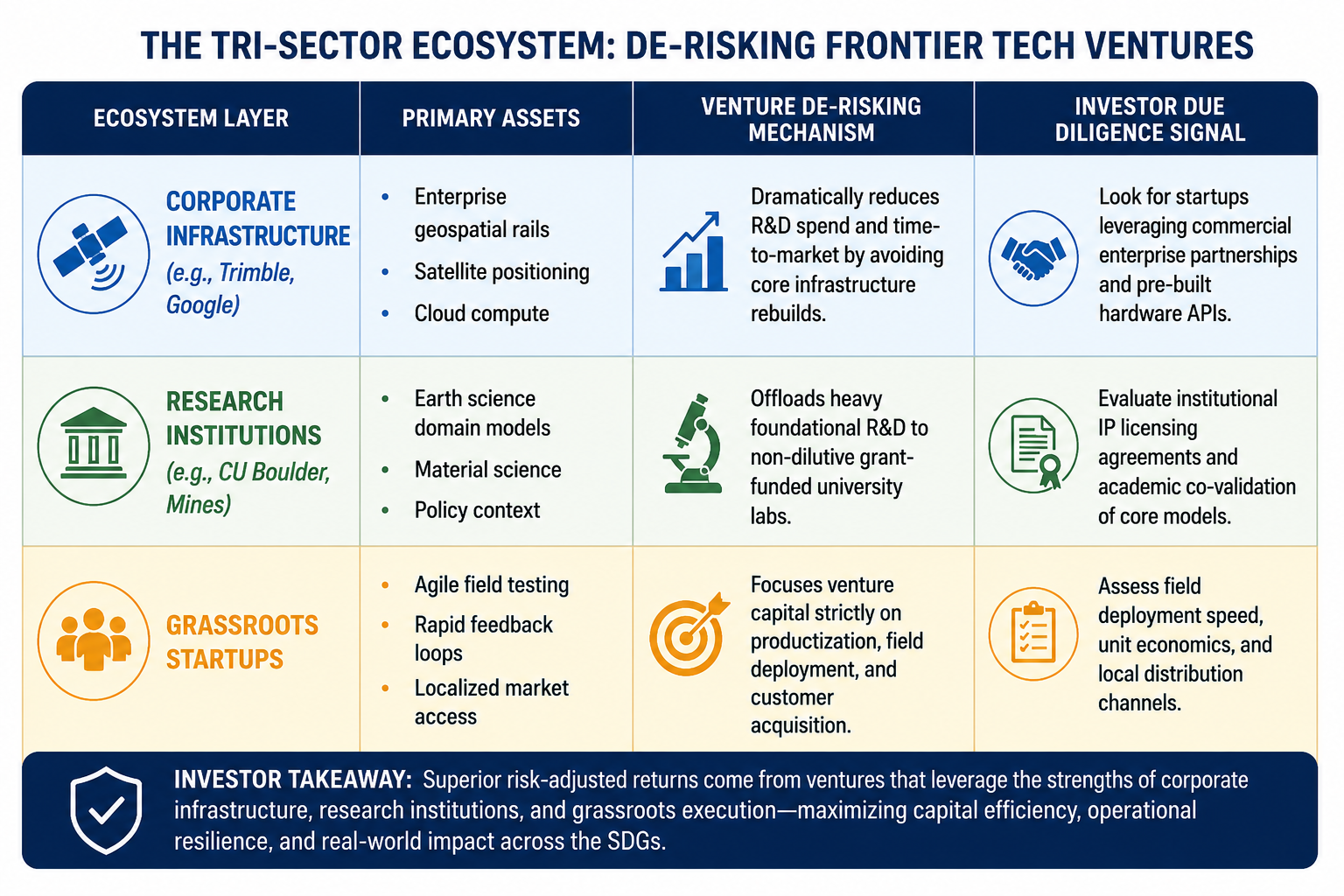
For investors, evaluating how effectively a startup leverages existing corporate infrastructure and university research is a primary metric for capital efficiency and dilution mitigation.
2. Contextual Literacy as an Operational De-Risking Metric
In consumer software, "user friction" costs conversion rate percentage points. In global development and frontier markets, ignoring local operational realities results in total write-offs. An elegant technical solution that fails to account for regional governance, informal trade flows, or localized maintenance capabilities is an unviable investment.
When conducting due diligence on frontier market startups, ESG and SDG investors should look past sleek product demos and evaluate contextual literacy as a proxy for operational resilience:
Governance & Local Stakeholder Alignment (SDG 16): Does the startup have embedded local buy-in? Technologies deployed top-down without local institutional ownership routinely face regulatory hurdles or community abandonment post-deployment.
Unit-Level Repairability & Supply Chain Resilience: High-precision hardware must survive local conditions. If maintaining a sensor array requires specialized parts imported across complex customs barriers, downtime will erode operating margins.
Algorithmic Local Literacy: AI and remote sensing models trained exclusively on Western datasets frequently hallucinate when applied to tropical canopy dynamics, informal agricultural plots, or arid topographies. Models must be validated against ground-truth field data.
3. Underwriting Edge Architecture and Data Sovereignty
For SDG investors focused on resilient infrastructure, technical diligence must focus on hardware-software architecture under extreme conditions. Relying on continuous cloud connectivity in low-bandwidth or politically unstable environments introduces unacceptable single points of failure.
To underwrite long-term technical defensibility, investors should look for three architectural indicators:
Edge Compute Optimization: The startup’s software stack must deploy compressed AI models directly to low-power edge hardware, allowing local data processing and decision-making during extended network blackouts.
Hardware-Agnostic Software Resilience: Software layers should seamlessly interface with variable sensor inputs, maintaining system uptime even as individual hardware components degrade or experience signal dropouts in extreme physical environments.
Zero-Trust Security & Data Sovereignty: In high-risk or conflict-adjacent regions, data security is tied directly to physical risk and ESG governance standards. Localized encryption and zero-trust data architectures protect both field personnel and sensitive environmental data.
The Investor Imperative at Colorado Startup Week
The next generation of high-performing impact ventures will not be built on surface-level metrics or asset-light tools that bypass real-world complexity. Superior risk-adjusted returns will belong to investors who know how to identify, underwrite, and scale hard-tech systems built for field resilience.
Whether you manage an institutional ESG fund, back early-stage climate tech, or invest across SDG mandates, join us during Colorado Startup Week for an investor-aligned panel on de-risking frontier technology.
Register Here for "Tech for Good: How Startups Are Rewriting the Rules"
