Guterres Wants to Govern AI. Does the UN Have the Leverage to Do It?
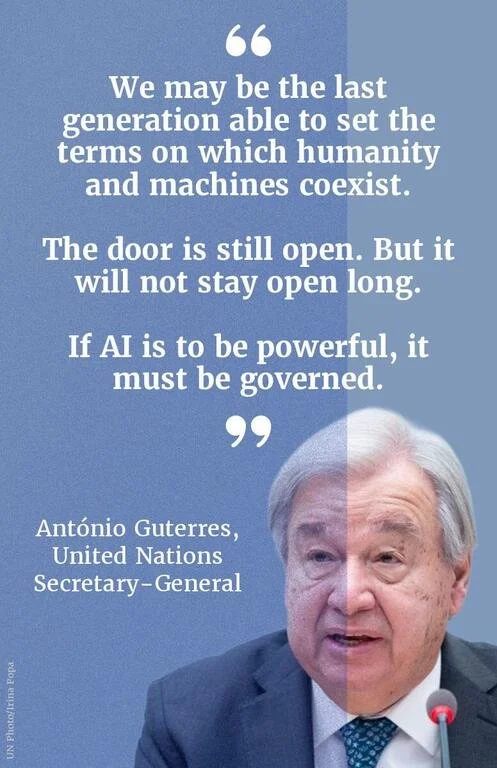
Colorado’s UNA in Boulder analysis of the Secretary-General's opening address to the first UN Global Dialogue on AI Governance, Geneva, 6-7 July 2026
On Monday, Secretary-General António Guterres stood before the first-ever Global Dialogue on AI Governance in Geneva and delivered a message he has now been repeating, in one form or another, for nine years: innovation needs guardrails, and the world is running out of time to build them. He paired the appeal with a warning about "killer robots," a call for a Child Safety Pledge, and a demand that AI's environmental footprint be measured and disclosed. It was, by any measure, a comprehensive and morally serious speech.
It also arrived at a summit with no power to bind a single state to anything.
For Colorado’s UNA members who care about multilateralism, that gap between the scale of the problem and the strength of the tools on offer is worth sitting with. Below is a balanced look at where the Secretary-General's stance is strong, where it strains against political and structural reality, and the questions our chapter should be asking as this process heads toward its next session in New York in May 2027.
What Guterres Got Right
Give credit where it's due. Guterres named four priorities in Geneva — common safety standards, human-rights red lines, capacity-building for the Global South, and environmental transparency — and each addresses a documented, not hypothetical, harm.
On child safety, the case is close to airtight. The Secretary-General's framing — that societies test toys and vet medicines before they reach children, but let AI systems reach them "before anyone asked what it would do to them" — lands because it's true, and because examples already exist of minors being steered toward self-harm or exploited through AI-generated sexual imagery. General Assembly President Annalena Baerbock reinforced this by citing figures showing that the overwhelming majority of deepfakes are sexual in nature and target women and girls. That is a structural harm, not an edge case, and a governance framework that fails to address it at the model level — not just the platform level — has a real gap.
On the digital divide, Guterres also has the numbers on his side. The independent scientific panel briefing the Dialogue found that the United States holds roughly 75 percent of the world's top AI supercomputing capacity and China another 15 percent, leaving a rounding error for everyone else. Framing that concentration as a "sovereignty gap" as well as a development gap is an accurate description of what's at stake for the more than 190 other states in the room.
The Searching Questions
That said, a fair critique has to ask what this speech — and the process around it — can actually deliver.
Where is the treaty Guterres himself set as the deadline? In his 2023 New Agenda for Peace, the Secretary-General recommended that states conclude a legally binding treaty banning lethal autonomous weapons systems by 2026. That deadline has now arrived, alongside the very summit meant to advance it, and no treaty exists. Calling autonomous weapons "morally repugnant" is a strong line. It is not a prohibition. UNA Boulder members might reasonably ask: at what point does an unmet self-imposed deadline start to erode the credibility of the next one?
Can the UN govern a technology it doesn't have the leverage to govern? The United States controls the overwhelming share of the compute that makes frontier AI possible, and its government has explicitly rejected "centralized control and global governance of AI" as a matter of stated policy. A voluntary framework for frontier-model safety review, issued by the same government in June 2026, notably creates no mandatory licensing requirement. Any international standard — binding or not — depends for its practical effect on the cooperation of the state that controls the infrastructure. A dialogue that the dominant compute power attends but formally rejects the premise of is a different thing than a governance body with teeth. What, concretely, does "worthy of global trust" mean if the largest player in the room isn't buying in?
Is the money behind this proportionate to the ambition? Guterres noted that private capital flowing into AI infrastructure is now around $500 trillion, against which public investment in AI capacity for developing countries is, in his own words, "a rounding error." The response announced in Geneva — a Global Network for Exchange and Cooperation on AI Capacity Building, backed so far by more than 20 countries — is a genuine step. It is also, by orders of magnitude, a mismatch for the scale of the divide he just described. Is pledging cooperation the same as closing a five-hundred-trillion-dollar gap, or is it the beginning of a much longer negotiation over who actually pays?
Who enforces the pledges, and how? The Child Safety Pledge and the AI Environmental Transparency Initiative both rely on companies volunteering to measure, disclose, and self-report — on carbon and water footprints, on child-safety testing, on detecting and removing sexual abuse material generated by their own systems. Voluntary disclosure regimes have a mixed record across other industries. What happens when a company simply declines to sign? Who verifies the disclosures that are made? And on the renewable-energy commitment specifically — powering every data center by 2030 — is that a target with a mechanism behind it, or an aspiration attached to a deadline four years out, at exactly the moment data-center electricity demand is projected to overtake all but five nations' total consumption?
Is a "dialogue" the right instrument, or is it a way to defer the harder conversation? The UN has been careful, correctly, to describe Geneva as the start of a process rather than a decision point, modeled loosely on how climate assessments feed intergovernmental negotiation without dictating it. That comparison cuts both ways. Decades of climate assessments have produced excellent shared evidence and, by most independent accounts, insufficient decisive action on the timeline the science demanded. If the Independent Scientific Panel's own warning is that AI's risks are outpacing scientific understanding and governmental capacity to adapt, is a deliberative, consensus-based forum — however inclusive — built for the speed the problem requires?
Does inclusion at the table translate into influence over outcomes? Guterres rightly emphasized that, for the first time, every country has a seat at the Global Dialogue. That is a genuine and valuable feature of the UN system that few other venues can offer. But a seat at the table is not the same as parity of leverage when the underlying compute, data, and talent remain as concentrated as the panel's own figures show. Is universality here primarily about legitimacy and norm-setting — valuable in its own right, as the decades-long trajectory of the "killer robots" campaign suggests — or is it also, functionally, a way to manage expectations about how much this Dialogue can change on its own?
Why This Matters for UNA Boulder
None of this is an argument that the UN should stay out of AI governance — quite the opposite. Multilateral norm-setting has historically moved slower than the crises that prompted it, from landmines to ozone to nuclear non-proliferation, and it has still mattered, shaping procurement rules, export controls, and public expectations long before treaties caught up. The honest version of support for this process is one that holds it to its own stated deadlines and asks, at every session, whether the next Dialogue produced a mechanism or only another declaration.
As our chapter continues to track UN engagement with AI governance ahead of the May 2027 session in New York, the most useful question we can keep asking isn't whether Guterres is right about the risks. On the evidence, he largely is. It's whether the instruments on the table — dialogues, pledges, voluntary disclosures — are proportionate to a technology that, by the UN's own scientific panel's account, is already outpacing the world's capacity to understand it.
UNA Boulder will continue following the Global Dialogue on AI Governance process and welcomes members interested in AI policy advocacy to get involved ahead of the 2027 New York session.