Boulder's Climate Scientists Weigh In: Why the World Just Retired Its "Doomsday" Warming Scenario
If you scrolled through climate headlines recently, you probably saw some version of this claim: "The UN just admitted its worst climate predictions were wrong." President Trump said as much on social media in May, cheering what he called an admission of failure. Skeptic blogs ran with it. But talk to the scientists at NSF NCAR in Boulder (some of whom helped write the underlying research) and you get a very different, and more interesting, story.
What actually happened
In April 2026, an international scenario-design team led by Dutch researcher Detlef van Vuuren published a paper in Geoscientific Model Development laying out the next generation of climate scenarios, known as ScenarioMIP for CMIP7 (the seventh Coupled Model Intercomparison Project). These scenarios are the backbone of nearly every climate projection you've ever seen — they translate assumptions about population, energy use, and policy into greenhouse gas trajectories that climate models then turn into temperature, sea-level, and rainfall projections.
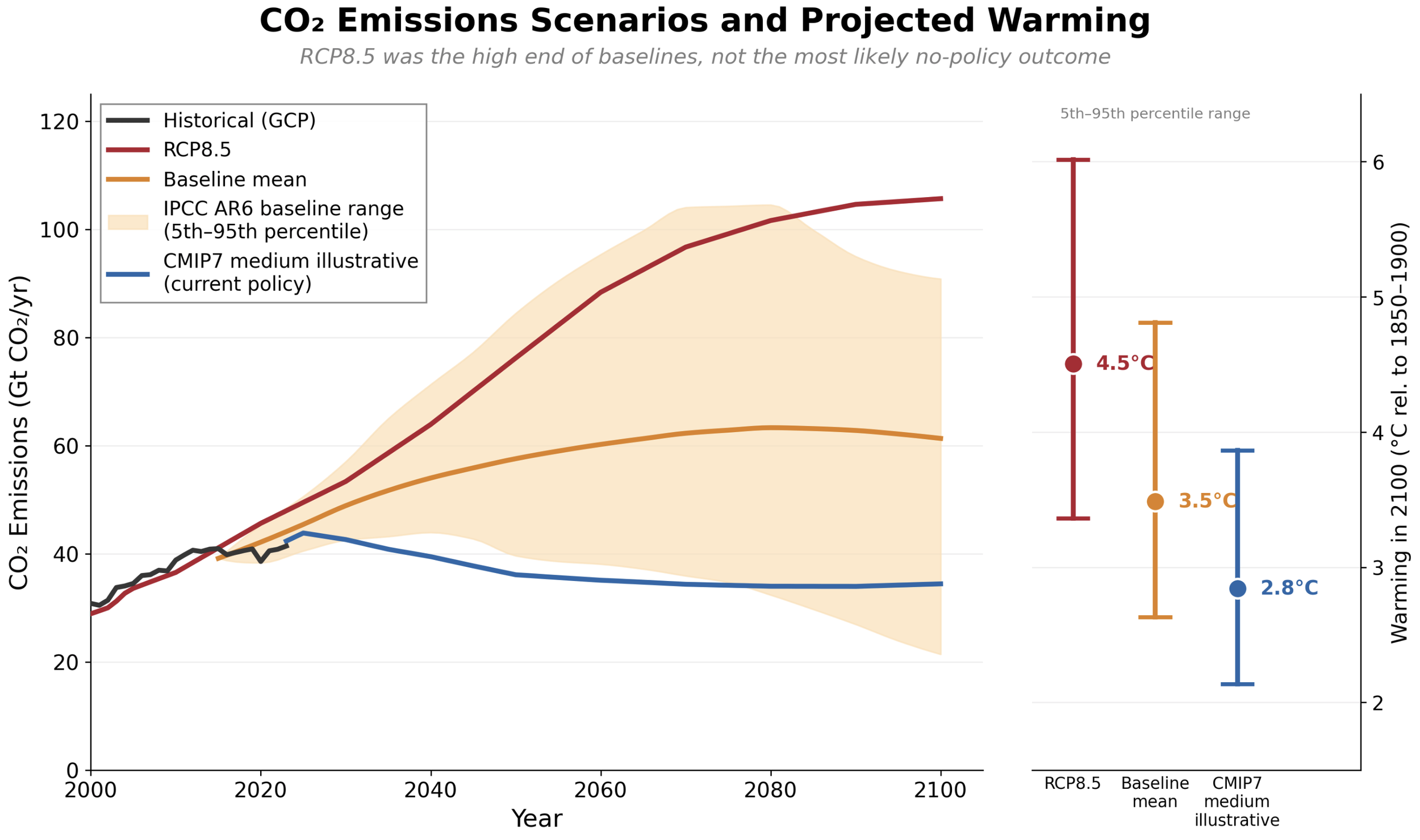
The headline change: the team formally retired RCP8.5 and its successor SSP5-8.5 — the extreme "business as usual" scenarios that assumed the world would triple down on coal and largely abandon climate policy through the end of the century. A related high-emissions pathway, SSP3-7.0, was scaled back too. Under RCP8.5, global warming could reach nearly 5°C above pre-industrial levels by 2100. The new "High" scenario in CMIP7 tops out closer to 3.5°C — still a very hot, very disruptive world, but no longer the runaway scenario that has anchored two decades of worst-case climate research.
NSF NCAR's fingerprints are all over this. Boulder-based climate scientist Benjamin M. Sanderson, part of the National Center for Atmospheric Research's Climate and Global Dynamics group, is a co-author on the ScenarioMIP-CMIP7 paper and helped run the emulator calculations used to translate the new emissions pathways into temperature outcomes. NCAR — sponsored by the National Science Foundation and managed by Boulder's own University Corporation for Atmospheric Research (UCAR) — has been one of the world's central hubs for the Earth-system modeling that feeds these international assessments, so this wasn't a decision made in some distant UN office. Boulder scientists were literally at the table.
Why scientists moved on from RCP8.5
RCP8.5 was originally built as one of several equally plausible pathways. But over the past decade, an increasing chorus of researchers — including University of Colorado–adjacent climate policy scholar Roger Pielke Jr., a vocal critic of the scenario — argued that RCP8.5 had drifted far from anything resembling a realistic future. Coal use has not exploded the way the scenario assumed. Renewable energy costs collapsed faster than almost anyone predicted in the 2010s. Global climate policy, however imperfect, is real and growing.
As the team behind the new scenarios put it, high-end emissions levels "have become implausible, based on trends in the costs of renewables, the emergence of climate policy and recent emission trends." In plain terms: the world's actual trajectory, however far from ideal, never matched the doomsday case — so the models were updated to reflect that.
What this does — and doesn't — mean
This is where a lot of the viral commentary went sideways. Retiring RCP8.5 is not an admission that climate change was overstated or that prior IPCC assessments were "wrong." It's the opposite of a scandal: it's climate science doing what science is supposed to do — updating projections as new data comes in, the same way epidemiologists update disease models as real-world transmission data arrives.
A few things are worth holding in your head at once:
The new worst case is still bad. A 3.5°C world blows past every internationally agreed climate target and would bring severe heat, drought, and sea-level impacts.
Retiring the extreme emissions scenario doesn't erase the risk of extreme impacts. Climate scientists who reviewed the change point out that the IPCC's own impacts assessments found that risks across major categories — food security, extreme heat, ecosystem collapse — have increased for any given level of warming, even as the emissions ceiling came down. Lower emissions doesn't automatically mean lower damage per degree.
Thousands of existing studies used RCP8.5 as an input — everything from U.S. National Climate Assessments to Federal Reserve stress tests to insurance risk models. Those don't become false, but researchers and institutions will need to reassess which of their conclusions depended heavily on the now-retired extreme case.
We've also lost the best-case scenario. The new framework largely eliminates pathways that keep warming under 1.5°C without significant "overshoot" and later drawdown. The most optimistic realistic future now involves temporarily exceeding the Paris Agreement's 1.5°C target before, hopefully, coming back down.
The UN hasn't gone quiet — it's gotten sharper
It's tempting to read "worst-case scenario retired" as "UN dialing back its warnings." That's not what's happening. The World Meteorological Organization and UN Secretary-General António Guterres have continued to describe the planet as being in a state of "climate chaos," and the WMO recently put the odds at roughly 75% that global average temperatures will temporarily exceed 1.5°C in at least one year between 2026 and 2030. Record heat, accelerating warming trends, and near-term risk are all still very much part of the UN's message — the change is about which long-term emissions pathway is realistic to model, not about how urgent the problem is.
The Boulder angle
For a city built around federal climate and atmospheric science — NSF NCAR, NOAA's Boulder laboratories, CU Boulder, and the Cooperative Institute for Research in Environmental Sciences (CIRES) — this story lands close to home. It's also arriving at an uneasy moment for NCAR itself: the center has spent the past several months navigating uncertainty over its federal funding and scope following White House directives to NSF to "rescope" its work. That backdrop makes it all the more notable that NCAR scientists remain central authors on the very research redefining how the world thinks about climate risk.
The takeaway for Boulder readers: the science got more precise, not softer. The nightmare scenario of unchecked, ever-accelerating fossil fuel growth increasingly looks like it won't happen — a real, if partial, victory for decades of climate policy and clean energy investment. But the world these scientists are now modeling as "plausible" is still one of serious, disruptive warming, and near-term extreme heat risk hasn't gone anywhere.
Sources: Van Vuuren et al., "The Scenario Model Intercomparison Project for CMIP7 (ScenarioMIP-CMIP7)," Geoscientific Model Development (2026); World Climate Research Programme CMIP7 scenarios explainer; NSF NCAR/UCAR publication records; The Conversation; The Climate Brink; Christian Science Monitor; Bloomberg; Washington Post; UN News; Yale Climate Connections.