Your News You Never See: What Colorado's Anniversary Year Can Teach Us About the World We Actually Live In

I don’t know about you, but my phone is lying to me about the state of the world. Not with fake stories but with true ones, curated by an algorithm that has learned exactly one thing about the nature of human attention: fear holds the mind longer than hope does or “if it bleeds, it leads”. This article seeks to try to adjust this dreaded algorithm’s lens to help see the world more as it truly is.
This year hands Colorado residents an unusual gift; a stack of anniversaries that happen to line up almost perfectly. Colorado turns 150 this year, admitted to the Union in 1876. The United States turns 250, its own semiquincentennial. It has been 80 years since the United Nations was founded out of the wreckage of a war the old international system failed to prevent. It is also notably 90 years since Emperor Haile Selassie stood before the League of Nations and described in plain and devastating terms what it looks like when the world does nothing while a country is invaded and gassed.
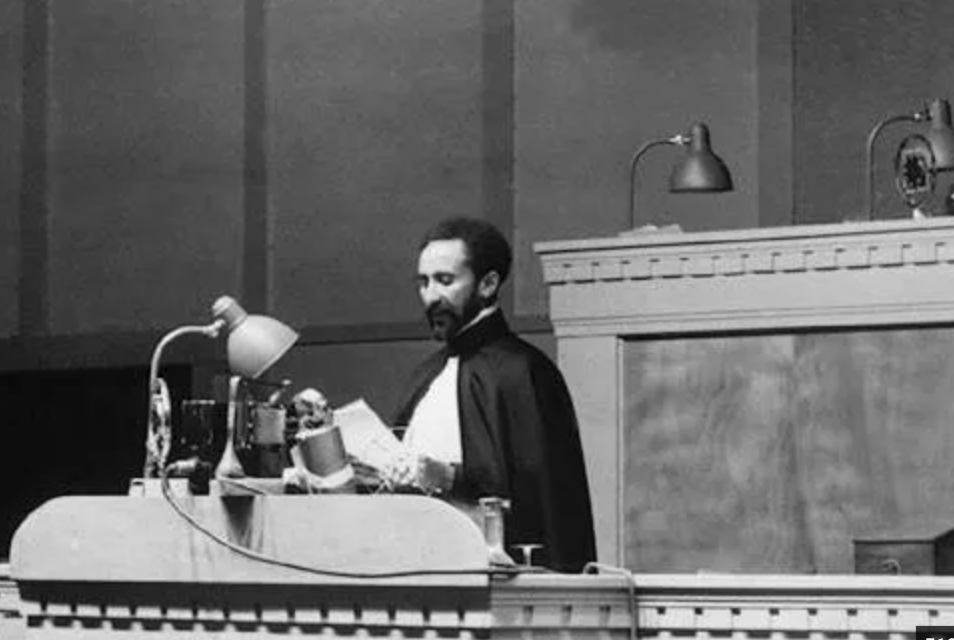
Emperor Haile Selassie
Four anniversaries, one thread: every one of them marks a moment when people decided the world they'd inherited wasn't good enough, and built something better. That thread is worth pulling on, especially now, because most of us are experiencing a state-of-the-world through a feed that was never built to show it to us holistically.
The Algorithm Doesn't Hate You. It Just Doesn't Care About Accuracy.
Here's the mechanism, stripped of mystery: social media platforms optimize for engagement, and engagement correlates with emotional intensity - outrage, fear, grief - far more reliably than it correlates with truth or proportion. A bridge collapsing gets shared. A bridge that stayed up, safely carrying commuters for the ten-thousandth day in a row, generates zero posts. Nobody films the war that didn't happen, the famine that was averted, the peace treaty quietly holding for the fortieth year. The feed isn't hiding good news out of malice. It's hiding it because good news, definitionally, doesn't spike.
The result, repeated a few billion times a day across a few billion feeds, is a kind of ambient distortion. Denver commuters scrolling on the light rail, Boulder students between classes, ranchers checking headlines between chores on the Eastern Plains — all of us end up with a mental model of the world that overweights its worst 5% by several orders of magnitude, simply because that 5% is what got pushed in front of us.
The Story Underneath the Story
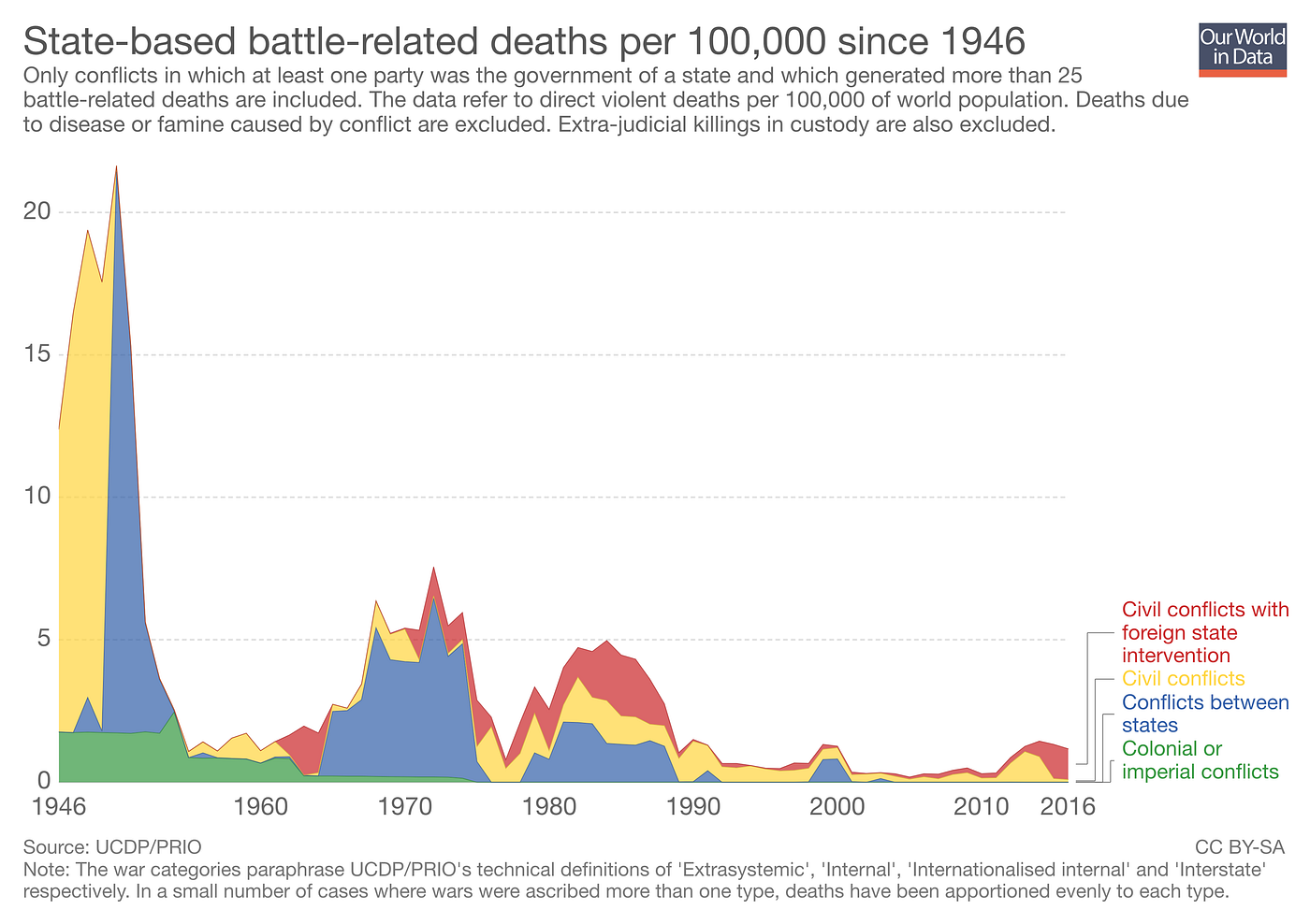
Here's what the feed doesn't surface: violent conflict, by most rigorous long-run measures, is rarer today than at almost any point in recorded history. Extreme poverty has fallen from the majority experience of humanity to a minority one within living memory. Child mortality, illiteracy, and preventable disease have all collapsed along trajectories that would have seemed like fantasy to the diplomats who founded the UN in 1945. These aren't fringe claims; they're the boring, well-documented consensus of people who study this for a living, and they get almost no attention because sustained improvement makes for terrible content.
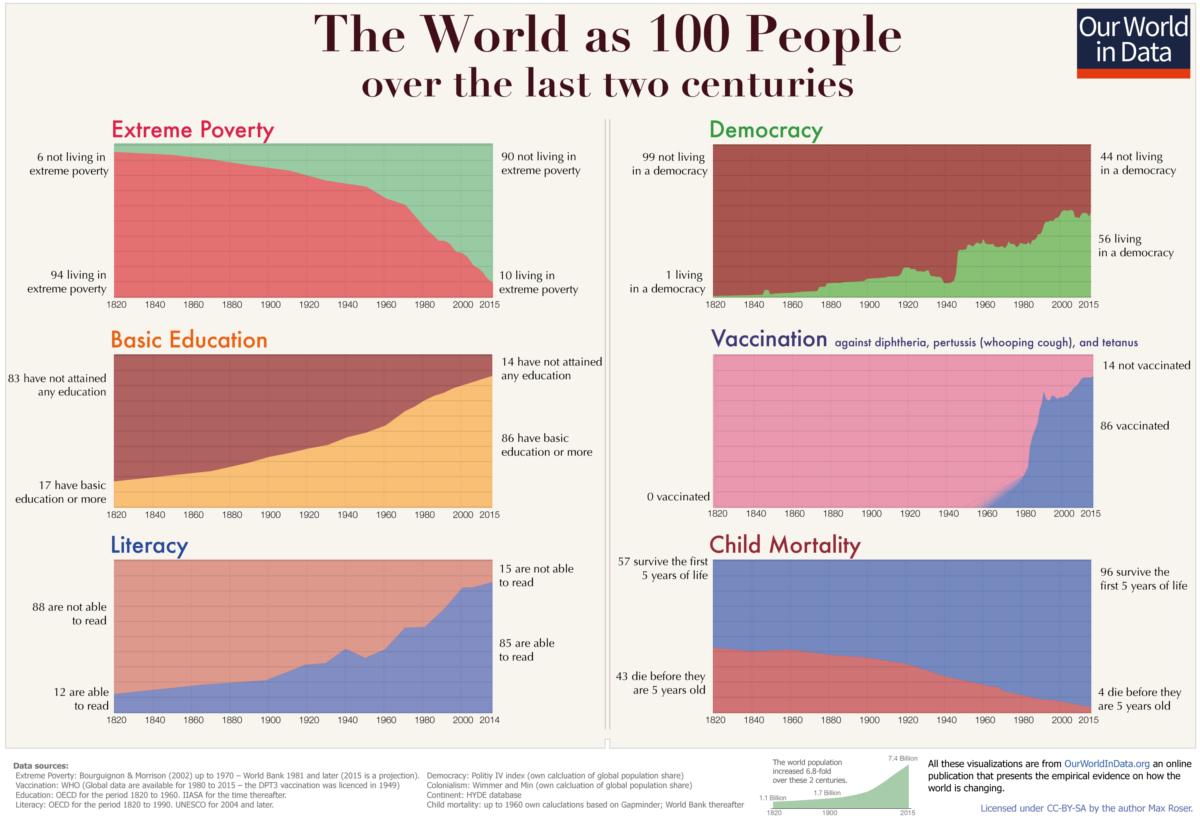
The UN, as an 80-year-old institution, exists precisely because the generation before it learned the cost of looking away. The League of Nations that Haile Selassie addressed in 1936 had no mechanism to stop what he was describing, and within a few years the entire system collapsed into the deadliest war in human history. What came after wasn't perfect, and nobody serious claims it is. But it has coincided with the steepest, broadest improvement in human welfare the species has ever recorded. War, famine, and mass atrocity haven't disappeared but they have gone from being the ordinary condition of most of humanity to being the exception that makes headlines precisely because it's now unusual enough to shock us.
That's not spin. That's the data. It's just not what trends.
Why This Is a Colorado Story
It would be easy to treat all of this as distant - Geneva, Addis Ababa, the UN General Assembly, places few of us have ever stood in. But Colorado's own anniversary sits inside the same arc. A territory that became a state 150 years ago, joining a 250-year experiment in self-government that has itself gone through cycles of despair and repair - civil war, depression, world wars, civil rights struggles - and kept moving, however unevenly, toward a broader circle of who gets to fully belong. Coloradans living through this convergence of anniversaries are inheriting the same lesson Selassie's failure and the UN's founding both taught: institutions built after catastrophe, staffed by people who refuse to let the catastrophe repeat, are how a species with a violent feed in its pocket still manages to keep getting less violent.
Reading Past the Feed
None of this means looking away from real suffering - the wars still being fought, the injustices still unresolved, deserve clear eyes, not denial. But it does mean recognizing the feed for what it is: a highlight reel of the exceptions, mistaken by force of repetition for the rule. The actual rule, this year's stack of anniversaries reminds us, is slower, quieter, and far more hopeful than the algorithm has any incentive to tell you. Peace and prosperity aren't the miracle. They're the baseline we've been building, a little more each decade, for a very long time and the war on your feed is news precisely because, more and more, it isn't.
Two Theories, and Which One the Feed Is Feeding
There's an old argument in international relations that maps onto this uncannily well. In the early 1990s, Francis Fukuyama looked at the collapse of the Soviet Union and argued that humanity's long ideological contest was essentially over; that liberal democracy and open markets had won, and the rest was mop-up. A few years later, Samuel Huntington pushed back hard: history wasn't ending, he argued, it was reorganizing itself along older, deeper civilizational, cultural, and religious lines that would keep colliding long after ideology stopped being the thing worth fighting over.
For thirty years, commentators have argued about which of them got it right. But look at that debate through the lens of a curated feed, and a third possibility emerges: both men were describing something real, and the feed has simply chosen which one to sell you. Huntington's collisions make for gripping content with villains, stakes, and footage. Fukuyama's slow convergence does not; a country quietly getting richer, more literate, and more peaceful over twenty years produces no single clip worth sharing. So the feed, built to reward the shareable over the true, has been running an unintentional but relentless advertisement for the Clash of Civilizations, while the End of History keeps happening anyway, underneath the noise, one unremarkable data point at a time.
That doesn't mean Huntington was wrong - the quasi-states, proxy wars, and entrenched grievances he warned about are real and ongoing, and pretending otherwise would be its own kind of distortion. It means the two forces are running in parallel, and the feed has a structural bias toward showing you only one of them.
What This Asks of Us
This is where the anniversaries stop being trivia and start being instructions. Colorado's founders, the framers of 1776, the diplomats who built the UN out of a failed League, and the Emperor who stood before that failed League describing the cost of its inaction; none of them were spectators to their century. They were, in whatever small or large way was available to them, force multipliers for the slower, less shareable story. That's still the job. Not looking away from the Huntington half of the world, and not mistaking it for the whole of it either - but finding the specific, local, unglamorous place where you can add weight to the Fukuyama half: a campaign, an act of advocacy, a single dish shared with a stranger, a habit of nonviolence practiced daily whether or not anyone is watching. None of it trends. All of it is why, a little more each decade, the trend line still bends the way it does.