Reading Frank Vogl on Iran: What He Gets Right, and What He Leaves Unanswered
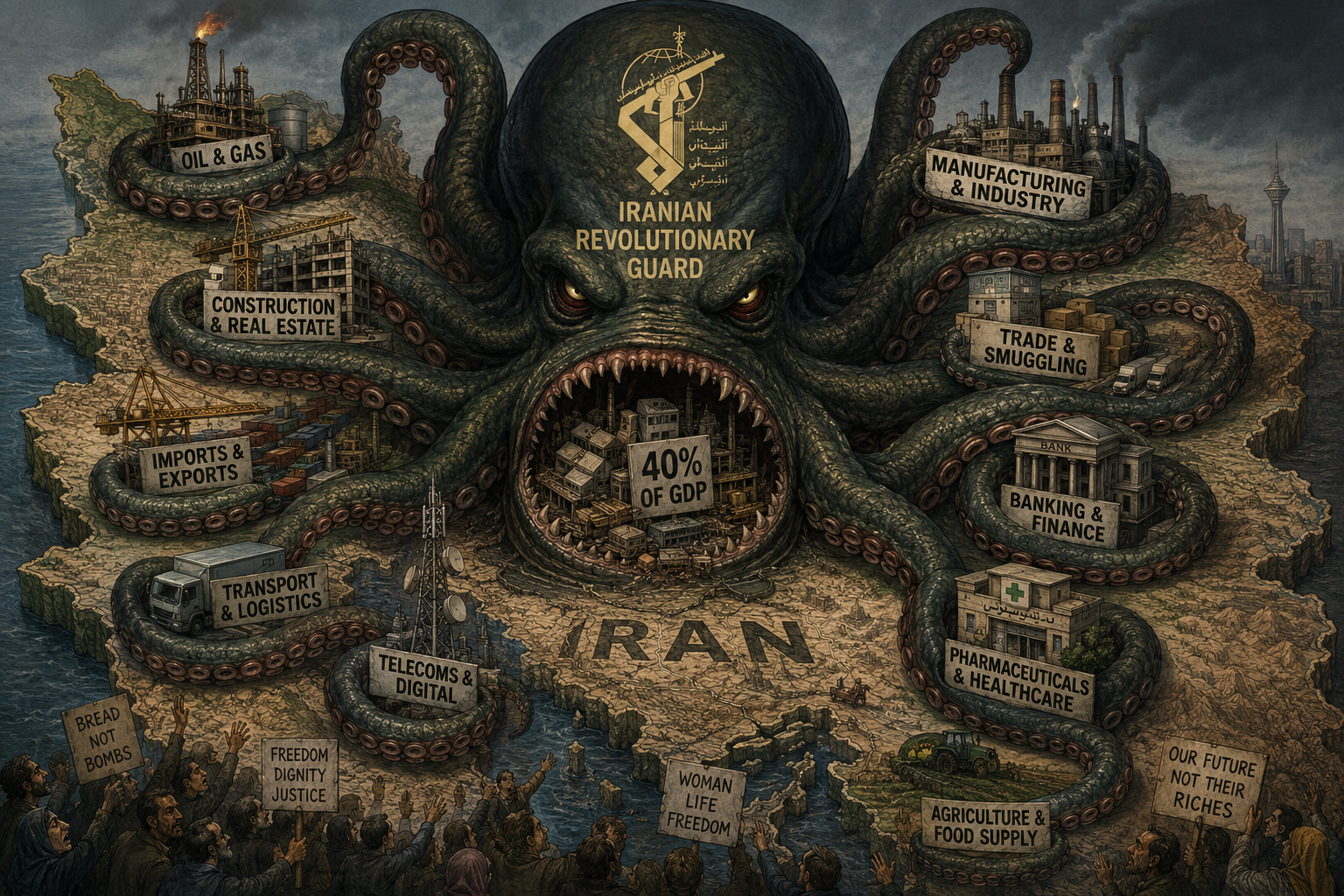
Frank Vogl's Strategic Assessment Memo for The Globalist, "American Delusions About Iran," is the kind of piece our chapter should read closely precisely because it argues against much of what we stand for. Vogl, who co-founded Transparency International, contends that American negotiators are being played, that Iran's leadership contains no meaningful reformers, and that the talks now underway are a device for buying time. I want to take the argument seriously, because the parts of it that are right matter more than the parts I would contest - and because I think the discomfort it creates for an organisation like ours is worth naming rather than managing.
What Vogl contributes
What Vogl offers, and what almost no mainstream coverage of Iran manages, is a structural rather than moral account of corruption. Most reporting treats kleptocracy as a character flaw of bad governments - regrettable, but analytically secondary to the real business of enrichment and proxy militias. Vogl inverts this. Corruption in his telling is not a symptom of the regime; it is the operating system. The Revolutionary Guard's expansion from military force into construction, then smuggling, then a holding-company empire spanning oil to pharmaceuticals is not incidental to Iranian foreign policy. It is the thing that foreign policy exists to protect.
That has predictive teeth. It explains why the 2015 agreement produced a brief startup boom and then a crackdown: openness that enriches people outside the network is a threat, not an opportunity. It explains hostage-taking as a transaction rather than a tantrum. And it explains why offering foreign investment as an inducement may misread what the other side wants.
Three ways of looking at a state
It is worth being precise about what kind of argument Vogl is making, because the precision changes what follows from it.
In Essence of Decision, Graham Allison examined the Cuban Missile Crisis through three lenses. Model I, the rational actor, treats the state as a single mind choosing means to serve ends. Model II, organisational process, treats state behaviour as the output of large institutions executing established routines - the state does not decide so much as run its programmes. Model III, governmental politics, treats outcomes as the residue of bargaining among players with different chairs, different stakes and different careers.
Almost all commentary on Iran, and nearly all of the political rhetoric surrounding the current war, runs on Model I. There is a unitary Tehran; it wants a bomb; it calculates; pressure alters the calculation. It is a tidy picture and it has been consistently wrong.
Vogl is arguing Model III, though he does not use the language. His Iran is not a mind but a coalition, dominated by a hydra-headed player - the IRGC and its economic empire - whose institutional interest in sanctions, scarcity and closed markets is direct and personal. Read that way, the regime's conduct at the table stops looking irrational and starts looking like a faction protecting its rents.
I would add the model Vogl leaves out, because it has just been tested in the most costly way imaginable. Model II explains persistence. The February strikes were framed explicitly as an attempt to induce regime change, and they killed the Supreme Leader. The regime did not collapse. It closed the Strait, struck across the region, absorbed six weeks of war, and arrived at a memorandum in June and a negotiating table in July. That is what Model II predicts: an organisation running its routines does not stop when the man at the top is removed, because the routines were never located in him. Decapitation is a Model I intervention aimed at a Model II problem.
Where I would press the argument
I part company with Vogl on two points, and I want to be careful about which.
The first is internal. His essay places its hope in the Iranian people, and specifically in the country's women and its ethnic and religious minorities, whom he rightly identifies as the most effective organisers of protest. But a few paragraphs earlier he floats a full economic blockade and targeted bombing of factories and oil terminals. I do not think those two positions can comfortably share a page. Blockades and strikes on economic infrastructure fall hardest on exactly the constituency he is counting on. Inflation, unemployment and medicine shortages do not distribute themselves evenly across a captured economy - a network holding a large share of GDP has reserves, and a nurse in Isfahan does not. There is also the plainer point our chapter cannot leave unsaid: deliberate attacks on civilian economic infrastructure sit badly with the Charter and with the law of armed conflict, whatever the strategic case.
The second concerns what the nuclear file is actually for. The prevailing image is of a state compulsively reaching for a weapon, with North Korea as the warning of what failure looks like. That fear is not unreasonable and we should not dismiss it. But it is a Model I image, and it does not fit the past five months especially well. A senior advisor to the supreme leader has said publicly that Hormuz is worth more than dozens of atomic bombs, and the closure of the Strait rather proved his point. A regime that has just demonstrated it can impose global costs without a nuclear weapon has a more complicated relationship to the weapon than compulsion. Latency may be the asset; the bomb may be the thing whose pursuit is useful. That is not a reassuring conclusion, but it is a different problem, and it responds to different instruments.
The tension, stated plainly
Let me be direct about where this leaves me, since I write as President of this chapter and not only as a reader.
The United Nations Association exists to champion the Charter, the multilateral system and the proposition that agreements between adversaries are worth making and worth keeping. Vogl's argument is corrosive to that proposition in a specific and serious way. If the dominant (multi-faceted) faction inside a state has more to lose from an open economy than from a sanctioned one, then the instruments we champion do not merely fail - they become useful to the other side as a mechanism for delay. Every round of talks is time. Every inspection protocol still unagreed is time. Our best tools become their best tools.
I do not think the honest answer to this is to repeat that dialogue is always preferable to war. I think three things instead.
First, arms control was invented for adversaries in bad faith. The JCPOA's architecture was not built on trust; it was built on the assumption that trust was unavailable, which is why it had continuous monitoring and enrichment caps at all. Vogl treats negotiation as requiring a counterpart in good faith and, finding none, concludes talks are futile. But whether the architecture can be rebuilt now is one question, and whether the absence of reformers makes it pointless is another. The essay does not quite distinguish them. The live disputes over country-wide inspections and spent fuel are precisely where that distinction gets settled.
Second, and less comfortably, the UN system was designed to bind states that are unitary enough to be bound. A Model III regime is genuinely hard for it to grip, because there is no single "them" whose signature disposes of the matter. This is not a reason to abandon the instruments. It is a reason to stop pretending the difficulty is merely one of political will on ‘their’ side.
Third, if corruption is the operating logic, then anti-corruption is not a moral supplement to security policy - it is a security instrument, and one the multilateral system is unusually well placed to wield. Asset tracing. Beneficial ownership transparency. The enabling professions in Dubai and London that Vogl's own book documents. These target the network rather than the population, which is exactly the discrimination that blockades cannot achieve.
The questions
So the questions I would put to Vogl, and to our members, are these.
- If corruption is the regime's operating logic, what does anti-corruption diplomacy look like as a first-order instrument rather than an afterthought?
- What multilateral mechanisms could isolate a kleptocratic network without immiserating the ninety-three million people living under it?
- How does an international order built for unitary states bind one that is a bargaining coalition?
- And if the real contest is between the regime and its own citizens, what is the international community's legitimate role in a struggle that is not ours to win?
One closing observation, offered without confidence. This week's strikes on Iranian shipping in the Caspian and Tehran's promise of retaliation suggest the conflict is finding new edges (and a wake-up call to Europe) rather than settling into one. Whatever else the coming months require, they will require the machinery for talking to people we have no reason to trust. It would be a poor moment to conclude that such machinery is naive.
Vogl has given us a better map of the problem than most. The route across it is still open for argument.
Read the full Vogl article: https://www.theglobalist.com/american-delusions-about-iran/