Part One: The United Nations at 81 — A Crisis That Could Become an Opportunity
International cooperation is under pressure. Reform may be the best way to preserve it.
The United Nations is facing one of the most difficult periods in its 81-year history. The United States, its largest historical financial contributor, is withdrawing support from dozens of international bodies. Budgets are shrinking, staffing is being reduced, and questions are being raised about whether parts of the UN system have grown too costly, too bureaucratic or too removed from their original purposes.
Much of the public discussion portrays these developments as an attack on the United Nations and the international order established after the Second World War. There are legitimate reasons for concern. International organizations depend on stable funding, political cooperation and the willingness of governments to honor their commitments. Abrupt withdrawals and financial uncertainty can disrupt operations serving some of the world's most vulnerable populations.
But there is another side to this discussion. The United Nations has accumulated complex administrative structures, overlapping responsibilities and longstanding difficulties holding itself and its member states accountable. Reform has been discussed for decades, often with less progress than its advocates hoped. The present crisis may finally provide the urgency needed to make substantial improvements.
For those of us who support the UN, these are not competing loyalties. We can defend the institution's founding mission while questioning whether its present structures are the best way to achieve it.
What is actually changing?
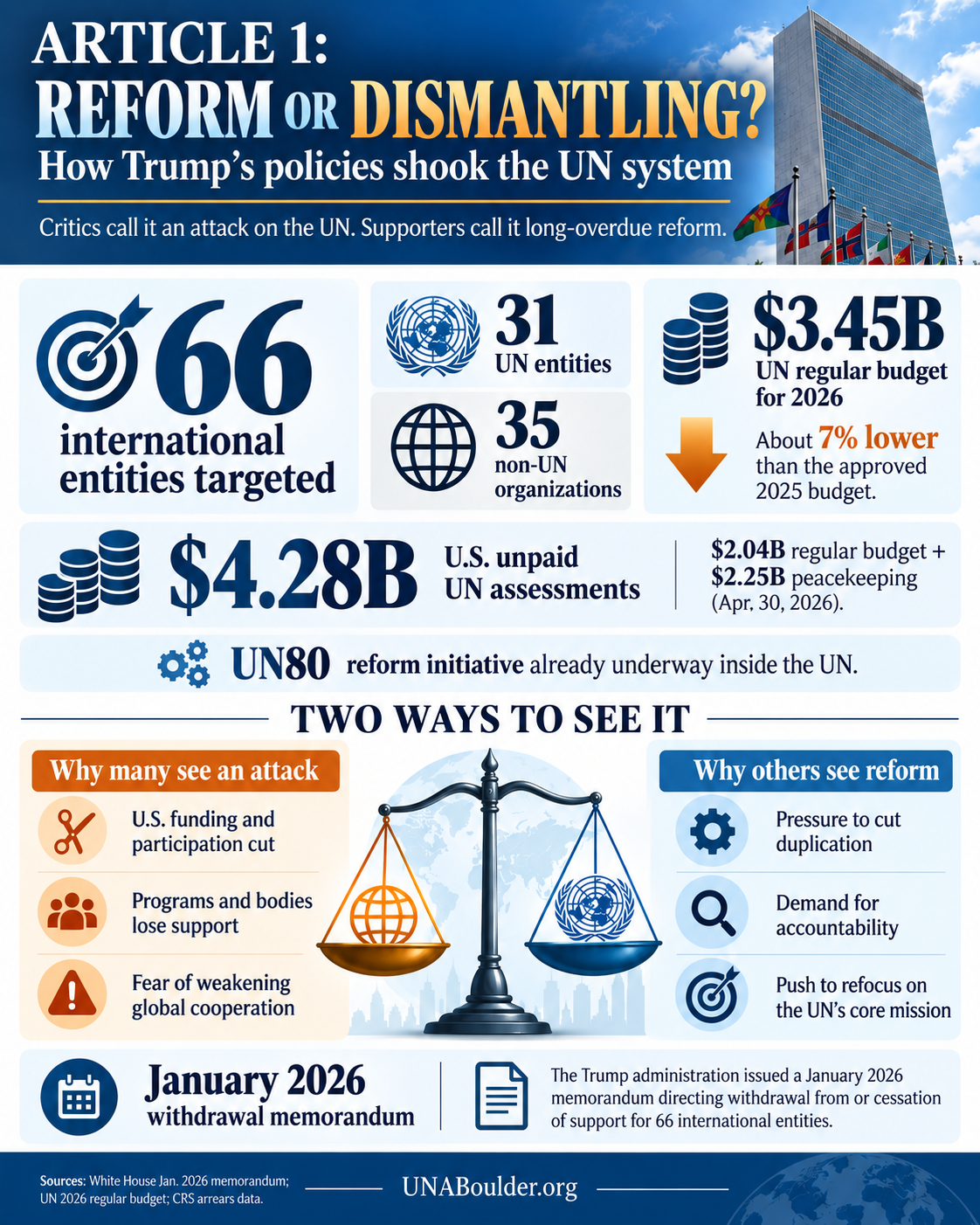
In January 2026, the Trump administration directed the United States to withdraw from, or cease participation and funding in, 66 international entities. Of these, 31 were associated with the United Nations and 35 were outside the UN system. They are not 66 principal organs of the UN, and the announcement does not mean that all withdrawals have been legally completed.
The administration has presented these actions as part of an effort to protect national sovereignty, reduce expenditure on ineffective international activities and redirect resources toward what it regards as core international responsibilities. Supporters of this approach argue that international organizations should regularly demonstrate their value and that government funding should never become an automatic entitlement.
Critics are concerned that withdrawals may weaken international cooperation, reduce American influence and interrupt work in conflict prevention, human rights, public health and humanitarian assistance. These concerns are particularly relevant when the affected institutions directly support the UN Charter's purposes.
Both arguments deserve examination on their merits. The important distinction is between eliminating unnecessary expenditure and eliminating useful international capabilities.
The financial pressures are real
The UN General Assembly approved a regular budget of $3.45 billion for 2026, approximately 7% below the approved budget for 2025. This is not the budget of the entire UN system. Peacekeeping operations and many humanitarian agencies operate through separate funding arrangements.
The financial challenge is made worse by outstanding contributions. As of April 30, 2026, the United States had approximately $2.04 billion in unpaid regular-budget assessments and $2.25 billion in unpaid peacekeeping assessments. These accumulated obligations represent a major problem for the UN's ability to plan and operate. Other member states have also delayed contributions.
There is a legitimate expectation that public money should be spent carefully and transparently. Governments have every reason to demand evidence of effectiveness. At the same time, withholding assessed contributions can create immediate operational problems without necessarily correcting the managerial weaknesses that prompted demands for reform.
The proper objective should be better results for the resources committed, not simply lower spending.
Reform is already taking place inside the UN
One encouraging development is that the United Nations itself has embarked upon significant institutional change. Secretary-General António Guterres's UN80 initiative is examining how the organization operates, how its many mandates have accumulated, and whether its structures can be reorganized to deliver better results.
In May 2026, the Secretary-General reported a 21% reduction in Secretariat posts for 2026, the merger of 11 administrative teams into a common platform serving approximately 6,000 personnel in New York, and the consolidation of ten payroll centers into a single global team. Administrative functions are also being moved to lower-cost locations where appropriate.
These are meaningful organizational changes. They suggest that the UN is increasingly prepared to challenge internal practices that may have been tolerated for too long. Some preparations for these reforms began before the current American funding reductions, and the initiative reflects the work of the Secretary-General and member states across the organization.
Nevertheless, fewer employees and lower administrative costs do not automatically constitute success. The question is whether those changes improve the UN's ability to carry out its responsibilities.
Returning to the founding mission
The UN Charter begins with a determination to save future generations from war. That ambition remains central to the organization's identity. Yet the Charter also commits member states to human rights, international law, friendly relations and cooperation on economic, social and humanitarian problems.
A renewed focus on the core mission must therefore embrace these responsibilities rather than treat them as later additions. Preventing war often requires diplomacy before violence begins, protection of vulnerable populations during conflict, and support for societies rebuilding after fighting ends.
We should also remember what successful international cooperation has accomplished. UN peacekeeping in Liberia helped create conditions for successive elections and a peaceful transfer of political power. International cooperation through the World Health Organization contributed to the eradication of smallpox. Technical agencies coordinate standards that make international aviation, communications and other everyday activities safer and more reliable.
These successes do not excuse institutional shortcomings. They demonstrate why we should care so much about correcting them.
An opportunity worth taking
It is possible to believe that parts of the United Nations are seriously in need of reform without believing that the institution itself is beyond repair. Indeed, the more indispensable an institution becomes, the greater the responsibility to ensure that it works.
The United States has an important role to play. Its influence can support financial discipline, transparent evaluation, more realistic mandates and stronger accountability. Other member states must share that responsibility, including by meeting their financial obligations and accepting scrutiny of their own conduct.
At UNA Boulder County, our interest is not in preserving bureaucracy for its own sake or judging international cooperation through domestic political loyalties. It is in supporting an institution capable of fulfilling the promises made in San Francisco in 1945.
The present crisis could damage the United Nations. It could also become an opportunity to make it more focused, effective and trusted. Whether it leads to renewal will depend on the reforms adopted, the commitments of member states and, ultimately, the results achieved.
The United Nations is too important to abandon and too important to leave unchanged.