Nuclear Age 2.0: Why Thorium Molten-Salt Reactors Change the Governance Equation
Every argument against expanding nuclear power eventually arrives at the same wall: even if a reactor is safe, can it actually be governed? Regulators have to plan for meltdowns that can't be walked back, waste that outlives the institutions meant to guard it, and a licensing system built for a handful of custom megaprojects, not a distributed fleet. That wall has been strong enough to slow nuclear expansion for decades — and reasonably so, given the technology it was built to govern.
Daryl Wallace's case is that the technology has changed enough to move the wall. Not incrementally — categorically. Thorium molten-salt reactors and the factory-built SMR model aren't a safer version of the old nuclear industry, in his view. They're a different kind of thing to regulate, and treating them like the old thing is itself the risk.
The Old Problem: Reactors That Fail Badly
Conventional nuclear governance exists to manage three linked hazards: a reactor core that can overheat and melt down if cooling is lost, waste that stays dangerous for tens of thousands of years with nowhere permanent to put it, and a construction model where every plant is a unique, multi-billion-dollar bet that takes a decade or more to build. Every regulatory rule — emergency zones, containment requirements, licensing timelines, decommissioning funds — is a response to those three hazards. That's the system Taddiken and others rightly point out wasn't built for anything else.
Wallace's argument is that thorium molten-salt technology attacks the first two hazards at the physics level, not just the paperwork level — which is exactly what would justify writing new rules instead of forcing new reactors through old ones.
"Safe-to-Fail" Instead of "Safe-Until-It-Isn't"
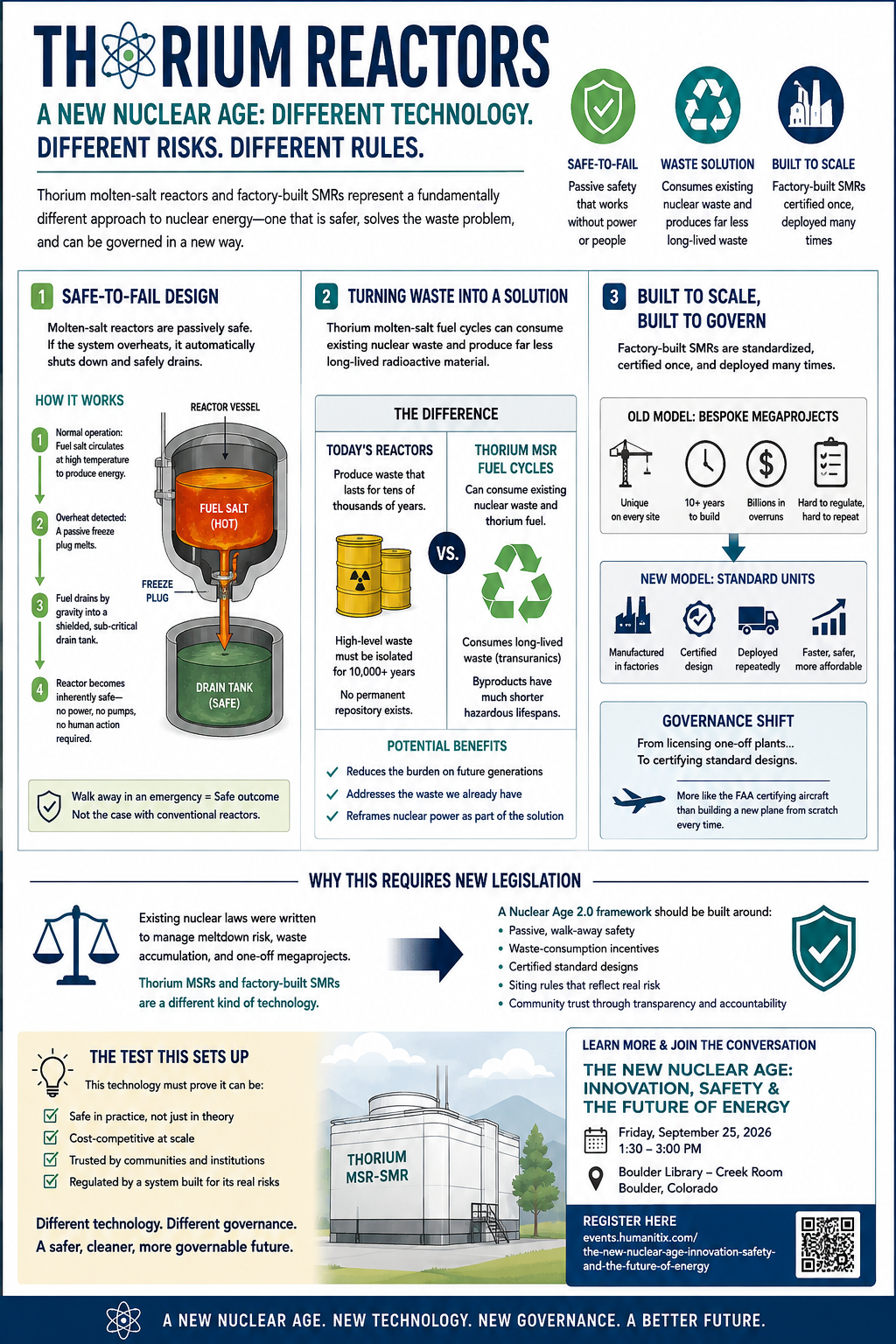
The defining feature of molten-salt reactor designs is passive safety that doesn't depend on operators, backup power, or emergency response getting it right in the first minutes of a crisis. Fuel is dissolved in liquid salt rather than held in solid rods; if the system overheats, a passive freeze plug melts and the fuel drains by gravity into a shielded, sub-critical containment tank — no pumps, no power, no human decision required. Where a conventional reactor depends on active cooling systems working correctly under stress — the exact failure chain that played out at Fukushima — a molten-salt reactor is designed so that walking away from it in an emergency is the safe outcome, not the catastrophic one.
That is a genuinely different risk category than "safer" in the marginal sense regulators are used to discounting. A regulatory system built around preventing meltdowns is built around a failure mode this design doesn't have in the same way. Wallace's case is that legislation should reflect that difference rather than pretending it doesn't exist.
Turning the Waste Problem Into a Waste Solution
The second hazard — waste that remains dangerous for millennia with no permanent repository anywhere in the world — has arguably done more to poison public trust in nuclear power than any single accident. It's the problem critics like Linda Pentz Gunter point to as unanswerable: no amount of reactor-design improvement fixes a waste stream that outlives every institution meant to watch it.
Wallace's response is that thorium and molten-salt fuel cycles don't just produce somewhat less waste — some designs can consume existing spent nuclear fuel and long-lived transuranic waste as feedstock, burning down material that would otherwise need guarding for 10,000-plus years into byproducts with dramatically shorter hazardous lifespans. If that holds up at scale, it reframes the technology from "another producer of the waste problem" to "a partial answer to the waste we already have." That's not a marginal safety improvement — it's a different relationship to the central objection that has stalled nuclear expansion for a generation.
From Bespoke Megaprojects to Governable Standard Units
The third hazard is economic and regulatory at once: every large reactor has historically been a unique, site-specific, multi-billion-dollar construction project, which is exactly why regulation of them is so slow and expensive — there's no template to reuse, no manufacturing learning curve, no standardized inspection regime that carries from one project to the next. Vogtle and Hinkley Point C are what that produces: nine-figure overruns, decade-long delays, costs shifted onto ratepayers.
Wallace's answer is South Korea's model — nuclear built the way aircraft or ships are built, as a standardized product manufactured in a factory and deployed as a repeatable unit, not reinvented on every site. Apply that model to SMRs and the regulatory task changes shape entirely. Instead of licensing a one-off, bespoke plant every few years, regulators would certify a standard design once and then inspect and permit deployment of that same certified unit repeatedly — closer to how the FAA governs a certified aircraft model than how the NRC has historically governed nuclear power plants. That's a genuinely different governance problem, and arguably a more tractable one: less novel engineering judgment per project, more consistent manufacturing quality control, and a track record that actually accumulates instead of resetting with every megaproject.
Why This Requires New Legislation, Not Just New Permits
Put those three shifts together — passive, walk-away safety; a fuel cycle that can consume existing waste instead of only adding to it; and a factory-certified deployment model instead of bespoke construction — and Wallace's case is that regulators are being asked to fit a fundamentally different technology through a licensing framework designed to manage meltdown risk, waste accumulation, and one-off megaproject construction. That's not a minor mismatch. It's the wrong tool for the job.
His argument isn't that this technology should be deployed without new rules. It's closer to the opposite: existing nuclear law wasn't written with a walk-away-safe, waste-consuming, factory-certified reactor in mind, and stretching 1970s-era regulatory categories to cover it either slows deployment to a crawl for no safety benefit, or forces regulators to approve something using categories that don't actually describe what they're approving. Neither is a good outcome. What the technology calls for, in his framing, is a genuinely new legislative and regulatory approach — a Nuclear Age 2.0 framework built around certified standard designs, waste-consumption incentives, and siting rules that reflect passive safety, rather than a patched version of rules written for a different generation of machines.
The Test This Sets Up
This is, notably, a case Taddiken's governance skepticism doesn't dismiss — it sharpens it. If Wallace is right that the technology is different enough to change the governance equation, the conclusion isn't "deregulate and build." It's "write the regulatory system this technology actually deserves, and don't let anyone deploy it under the old one in the meantime." Whether thorium molten-salt SMRs can deliver on cost — McNown's question — and whether communities and institutions will trust a genuinely new licensing framework — Oakes' question — are still open. But Wallace's claim is specific and testable: this isn't the same governance problem in a smaller package. It's a different problem, and it deserves a different answer than "trust the same rules that were written for Vogtle."
Register:https://events.humanitix.com/the-new-nuclear-age-innovation-safety-and-the-future-of-energy