If Kazakhstan, Why Not Colorado? Rare Earths, National Security, and the Case for Sustainable Mining at Home
A recent Impakter op-ed, "Rare Earths Are the New Oil", opens with a striking detail: a little-known American company with ties to the Trump family and to the son of the Secretary of Commerce has secured preliminary federal financing of up to $1.6 billion to develop a tungsten deposit in rural Kazakhstan. Tungsten isn't technically a "rare earth," but it belongs to the same broader family of critical minerals the U.S. needs for missile warheads, fighter jets, and semiconductors - and the deal is a vivid example of how far the United States is reaching to secure supply chains it once had at home.
The article's central argument is that rare earth elements (REEs) are becoming this century's oil: a resource so essential to modern technology, defense, and the energy transition that whoever controls it wields outsized geopolitical leverage. China currently dominates global REE processing (by most estimates, 85-90% of it), giving Beijing an OPEC-like grip on the inputs for EVs, wind turbines, smartphones, and precision weapons. The U.S. response so far has been to chase deposits and financing deals across the globe - Kazakhstan, Greenland, Central Asia - while comparatively underinvesting in known, mappable, domestic reserves.
Which raises the obvious question: if Washington is willing to put $1.6 billion behind a mine in rural Kazakhstan, why not Colorado?
Colorado already has the geology
This isn't hypothetical. The Colorado Mineral Belt - a well-studied swath of the state stretching from the San Juan Mountains to Boulder County - hosts documented deposits of beryllium, niobium, tantalum, titanium, vanadium, and rare earth elements, alongside more familiar critical minerals like lithium and graphite. The USGS has been mapping REE potential in Colorado since at least its 2010 national deposit inventory, which specifically documents Colorado occurrences.
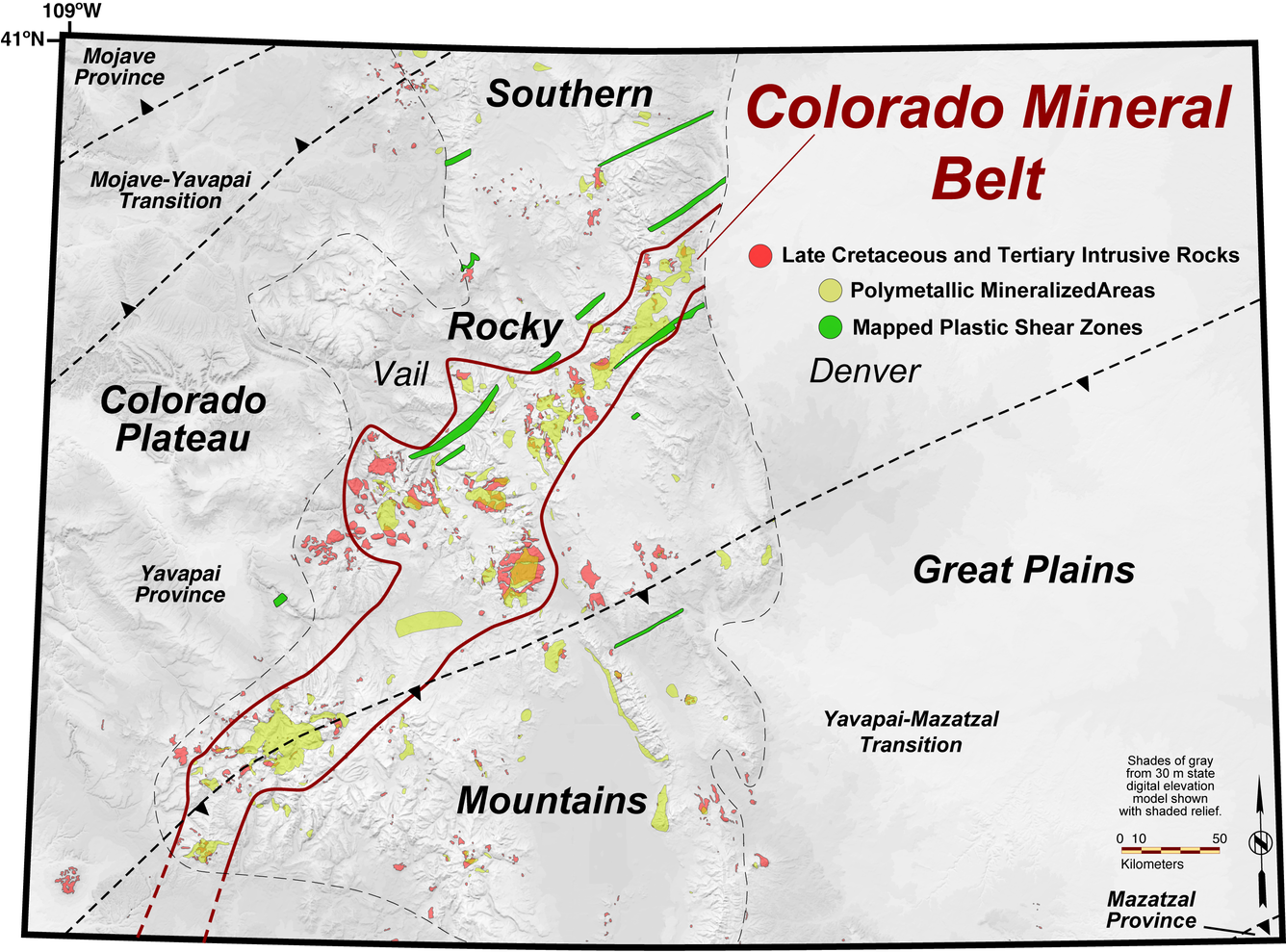
The Colorado Mineral Belt
More recently:
The USGS's Earth Mapping Resources Initiative (Earth MRI) has funded new airborne geophysical surveys, geologic mapping, and geochemistry work in the Wet Mountains of southeast Colorado, an area flagged for REE and critical-mineral potential.
The Colorado Geological Survey maintains an active strategic and critical minerals program, including a public data compilation of historic REE sampling results.
Researchers with the CORE-CM project (Carbon Ore, Rare Earth and Critical Minerals) have found REEs concentrated in shale layers above and below Colorado and Utah coal seams - an "unconventional" domestic source that sidesteps opening new hard-rock mines entirely.
Colorado is already home to part of the processing side of the supply chain: a rare earth separation pilot plant opened in Wheat Ridge in 2020, built to separate the full range of REEs on U.S. soil for the first time since 1999.
In short: the state doesn't need a $1.6 billion bet on unfamiliar terrain in Central Asia to participate in this supply chain. It needs sustained investment, permitting clarity, and research funding for deposits that are already mapped.
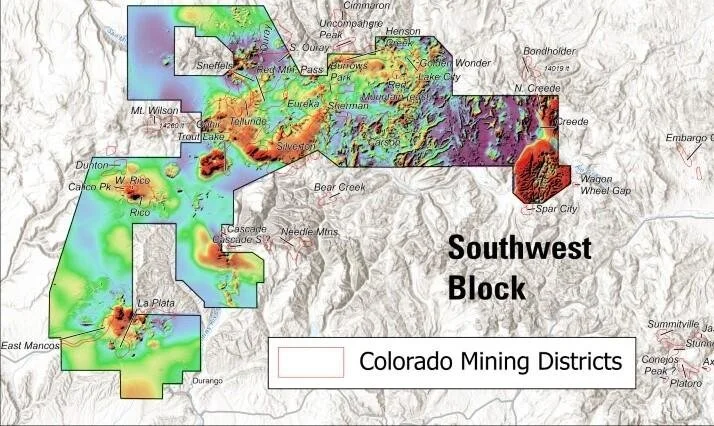
Colorado’s Mining Districts
The catch: how, not just where
None of this is an argument for mining first and asking questions later. Colorado's own mining history - from Gold King to Summitville - is a reminder of what happens when extraction outpaces environmental and community safeguards. Rare earth processing in particular involves acid leaching and radioactive byproducts (thorium and uranium routinely co-occur with REE ore), which makes siting, water protection, and tailings management non-negotiable, not optional add-ons.
This is exactly the gap the United Nations has stepped in to address. In April 2024, UN Secretary-General António Guterres convened a Panel on Critical Energy Transition Minerals, bringing together governments, industry, and civil society - with strong representation from mineral-rich developing countries - to answer a hard question: how do we scale up mineral extraction fast enough for the energy transition without repeating the exploitative patterns of the oil era? The Panel's September 2024 report, Resourcing the Energy Transition, lays out seven voluntary guiding principles, including that human rights must sit at the core of mineral value chains, that trade and investment must be transparent and fair, and that value chains must be environmentally sustainable and just - not just for producing countries abroad, but for producing communities everywhere, including in the U.S.
Those principles apply just as much to a project in the Wet Mountains as to one in the Democratic Republic of Congo. Guterres put it bluntly: "The race to net zero cannot trample over the poor." Colorado communities near potential mining or processing sites deserve the same standard.
Why this matters for Colorado’s UNA
This story sits squarely at the intersection of Colorado’s UNA in Boulder's core interests: multilateral governance, sustainable development, and how global frameworks translate into local policy. It's a chance to connect a national-security-driven federal financing story (the Kazakhstan tungsten deal) with a concrete local question Boulder County residents can act on - whether Colorado's own mineral wealth should be developed, and if so, under what standards.
A few discussion threads worth raising at a chapter event or in follow-up coverage:
Should Colorado adopt something like the UN Panel's guiding principles as a state-level permitting standard for any future REE or critical-mineral projects?
What would "sustainable, ecologically sound" REE extraction actually require here - water rights protections, tailings management, radioactive byproduct handling - and who enforces it?
Does relying on unconventional sources like coal-adjacent REE deposits (per CORE-CM) offer a lower-impact path than new hard-rock mining in the Mineral Belt?
How does the U.S. reconcile chasing overseas deals like the Kazakhstan tungsten investment with underutilizing well-mapped domestic reserves - and what does that say about the coherence of U.S. critical minerals policy?
Sources
Seifman, R. "Rare Earths Are the New Oil." Impakter.
U.S. Geological Survey, Principal Rare Earth Elements Deposits of the United States (SIR 2010-5220).
U.S. Geological Survey, Geophysical and Geological Characterization of the Colorado Mineral Belt.
U.S. Geological Survey, Earth MRI Funds Critical Minerals Projects in Colorado.
Colorado Geological Survey, Strategic and Critical Minerals.
Mining.com, High Concentrations of Rare Earths Found in Utah, Colorado Coal Mines.
Mining.com, Rare Earths Processing Facility Opens in Colorado.
United Nations, Secretary-General's Panel on Critical Energy Transition Minerals.
United Nations, Resourcing the Energy Transition: Principles to Guide Critical Energy Transition Minerals Towards Equity and Justice (full report, PDF).