
Beyond the Hype Cycle: How Startups Are Rewriting the Rules of Hard-Tech Field Deployment

Published for Colorado Startup Week https://events.humanitix.com/tech-for-good-how-startups-are-rewriting-the-rules-of-global-development
By Vikram Gopalan:
When tech founders talk about scale, the conversation usually focuses on user acquisition, monthly active users, or cloud compute efficiency. But in global development, international affairs, and multilateral policy contexts, "scale" looks entirely different. It is measured in kilometers of unmapped terrain, sensor arrays deployed across low-bandwidth regions, or an AI model delivering localized to sustain an endangered language or climate resilience data directly into the hands of a smallholder farmer.
If the UN’s Sustainable Development Goals (SDGs) represent the world’s most ambitious target list for human prosperity—from Industry & Infrastructure (SDG 9) to Climate Action (SDG 13)—emerging technology is often championed as the primary engine to get us there. Yet a persistent "deployment gap" remains. On one end, corporate titans build world-class geospatial, satellite, and cloud infrastructure. On the other, research institutions write foundational theory and policy frameworks. Early-stage ventures attempting to operationalize tech in complex frontier environments often find themselves trapped in the middle—stranded between clean laboratory models and messy international realities.
To move from vision statements to measurable SDG outcomes, the startup ecosystem must rewrite the operational playbook for hard-tech deployment.
1. Cross-Pollinating the Ecosystem: Corporate Footprints, Research Labs, and Grassroots Tech
Achieving SDG 17 (Partnerships for the Goals) requires moving past siloed innovation. Historically, early-stage startups attempting global impact have tried to build every layer of their technology stack from scratch—burning through capital and delaying field access. The smarter, more sustainable play is ecosystem cross-pollination.
Consider the unique tri-sector footprint running along Colorado’s Front Range. Tech leaders like Trimble and Google bring enterprise-grade infrastructure—from sub-inch satellite positioning to global cloud compute. Nearby academic institutions like the University of Colorado Boulder, DU’s Pardee and the Colorado School of Mines hold decades of specialized domain knowledge in data, earth science, autonomous sensing, and natural resource governance.
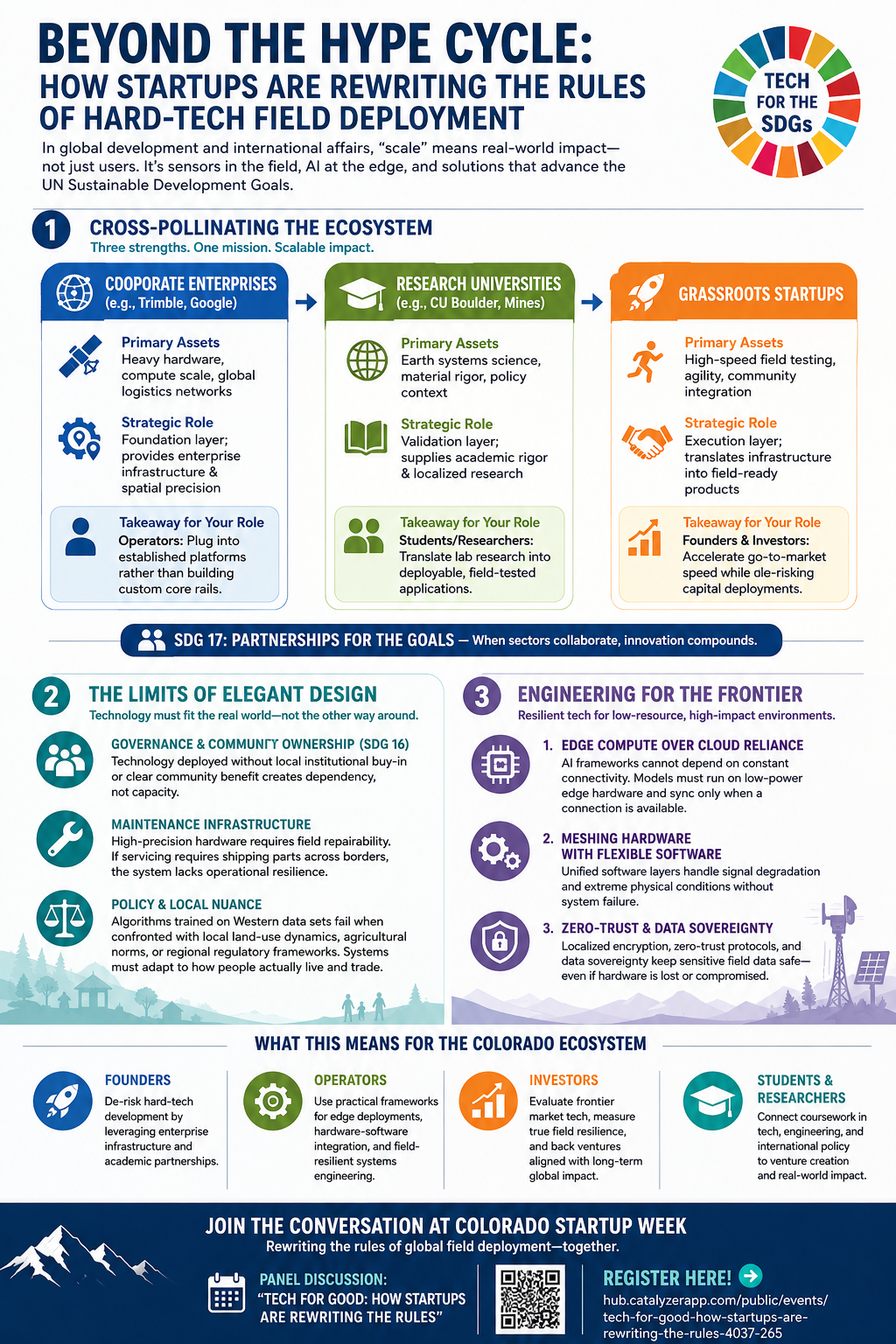
When early-stage ventures build deliberately at this intersection, they stop reinventing the wheel and start deploying scalable solutions aligned directly with international mandates.
2. The Limits of Elegant Design: Hard Engineering Meets Community Realities
In consumer tech, human-centered design (HCD) often gets reduced to clean UI, seamless onboarding, and frictionless digital UX. But in global development, HCD is an exercise in contextual literacy and local sovereignty. An elegant technical solution that ignores regional governance, informal economies, or physical maintenance cycles will fail the moment external support departs.
Governance and Community Ownership (SDG 16): Technology deployed without local institutional buy-in or clear community benefit creates dependency rather than capacity.
Maintenance Infrastructure: High-precision hardware requires ruggedness and field repairability. If servicing a remote sensor array requires shipping replacement parts across international borders, the system lacks operational resilience.
Policy and Local Nuance: Algorithms trained on Western data sets can fail when confronted with local land-use dynamics, agricultural norms, or regional regulatory frameworks. Systems must adapt to how people actually live and trade.
3. Engineering for the Frontier: Bandwidth, Hardware, and AI at the Edge
Beyond social dynamics, deploying technology into low-resource or unstable regions requires extreme technical resilience. When operating in environments with intermittent grid power, near-zero cellular connectivity, or high political instability, traditional cloud-first architectures crumble.
Building resilient frontier tech requires three core architectural shifts:
Edge Compute Over Cloud Reliance: AI frameworks cannot depend on constant connectivity. Models must be compressed, optimized, and deployed directly onto low-power edge hardware that processes data locally and syncs with central networks only when a connection becomes available.
Meshing Heavy Hardware with Flexible Software: Precision sensors, automated machinery, and remote environmental monitors require unified software layers capable of handling signal degradation and extreme physical conditions without system failure.
Zero-Trust & Data Sovereignty: In volatile environments, data security is a physical safety issue. Systems must implement localized encryption, zero-trust protocols, and strict data sovereignty controls so sensitive field data remains protected even if physical hardware is compromised.
What This Means for the Colorado Ecosystem
Unlocking technology's true potential for global impact requires alignment across our entire regional innovation pipeline:
Founders: Learn how to de-risk hard-tech development by leveraging enterprise infrastructure and academic partnerships.
Operators: Discover practical frameworks for edge deployments, hardware-software integration, and field-resilient systems engineering.
Investors: Understand how to evaluate frontier market tech, measure true field resilience, and back ventures aligned with long-term global impact.
Students & Researchers: See how technical coursework in computer science, engineering, and international policy directly connects to venture creation and real-world execution.
Join the Conversation at Colorado Startup Week
Bridging the gap between theory, corporate scale, and real-world execution requires tech leaders, researchers, investors, and advocates willing to rethink how we build technology for global impact.
Join us during Colorado Startup Week for an actionable panel discussion on how Front Range ventures are rewriting the rules of global field deployment. Follow link to find out more;
Register Here for "Tech for Good: How Startups Are Rewriting the Rules"
